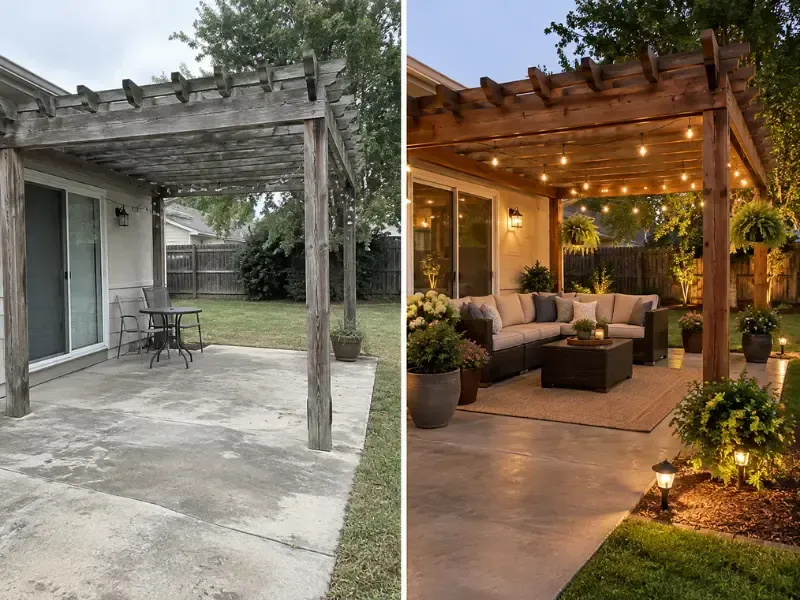
What Do Pergolas Services in Brentwood TN Include?
Pergolas Services cover design, permitting and build — plus one conversation that belongs at the start and almost never happens: are you going to grow something on it? A pergola is the only structure we build that people deliberately cover in living weight, and a vine changes the engineering, the material choice and the maintenance for good.
By Jeremy Bolton, Founder and Owner · Last updated September 7, 2026
Why Does Planting Change the Design?
Because a mature climber is a permanent load that wasn't there on the drawing.
Wisteria is the one that catches people. It's beautiful, it's fast, and it becomes genuinely heavy — a mature specimen carries substantial weight in stems, foliage and water, and unlike snow it never comes off. Climbing roses, trumpet vine and established grape do the same to a lesser degree. A pergola sized for shade and appearance can be under-sized for the plant somebody adds two summers later.
Three mechanisms are at work, and only the first is obvious.
Accumulating dead load. More stem, more leaf, more retained water after rain, every year. It doesn't plateau the way people assume.
Stem thickening. Woody climbers twine, then thicken. A stem wrapped around a rafter or a post keeps expanding against it, and over years that can crush, distort or split a member. It's slow and it's relentless.
Trapped moisture. Dense growth against timber holds water where the wood can never dry, which is exactly the condition that starts decay. Under Brentwood's canopy, where things dry slowly anyway, that compounds.
So if a climber is the plan — and on a lot where mature hardwoods already provide the shade, planting is often the actual reason for the pergola — say so at design stage. Heavier members, closer post spacing and larger footings are cheap to specify now and impossible to retrofit under an established vine.
What Happens to Maintenance Once It's Covered?
This is the consequence nobody mentions, and it decides the material.
You cannot refinish what you cannot reach. A timber pergola needs periodic cleaning and re-coating. A mature wisteria makes that physically impossible — you'd have to cut the plant back hard or remove it entirely, and after a decade that means losing the thing you built the pergola for.
Which produces a straightforward rule: if you intend to plant it, build it in something that doesn't need refinishing. Aluminium doesn't rot and never needs coating, so a vine growing over it is a maintenance question about the plant rather than the structure. A powder-coated finish handles being covered in a way that stained timber doesn't.
If you want timber anyway — and cedar under a climbing rose looks superb — accept the trade. Detail it properly at build so the exposed parts last on their own: standoff post bases keeping end grain off concrete, angled rafter tails that shed water, capped post tops, and every cut end sealed. Our Smyrna pergola guide explains why a structure made almost entirely of exposed edges lives or dies on those details.
What Is the Difference Between a Pergola and a Pavilion?
Quickly, because the words get used loosely.
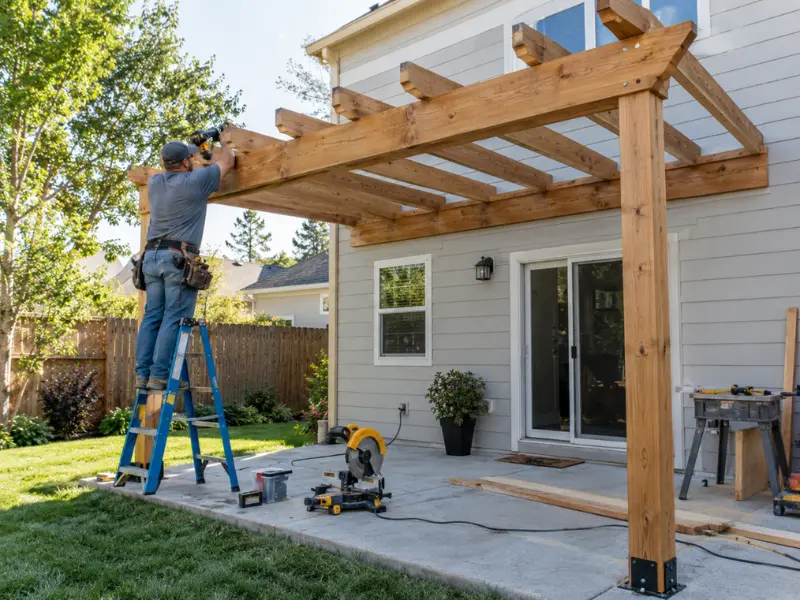
A pergola has an open or louvered roof of spaced rafters, and open sides. A pavilion has a solid roof, usually a full gable or hip, and is typically freestanding with a more substantial frame. A gazebo is a pavilion with a distinctive footprint, often octagonal. A patio cover has a solid roof against the house with open sides.
What is the difference between a pergola and a pavilion, in one line: the pergola filters, the pavilion shelters. Our patio covers guide covers solid roofs for Brentwood, including what a canopy does to drainage.
The distinction has blurred slightly because louvered pergolas can close into a sealed plane — effectively becoming a cover on demand. Our Franklin pergola guide covers those systems, including the counterintuitive rule that louvers should be opened rather than closed in high wind.
How Much Shade and Rain Cover Do You Actually Get?
Shade yes, rain no — and the shade is partial by design.
Do pergolas provide shade and rain protection is the question that produces the most disappointed customers, so here it is plainly. An open-rafter pergola throws striped shade that moves through the day and never fully blocks overhead sun. Rain passes straight through. If you want to sit out during a Middle Tennessee thunderstorm, you want a solid roof, not a pergola.
What changes the shade is geometry rather than size: deeper rafters at closer spacing block more low-angle sun, and rafter direction determines when the shade falls — north-south rafters shade around midday, east-west in the morning and late afternoon. The Franklin guide works that through.
Two Brentwood-specific notes. Under mature hardwoods the sun is often already handled, so a pergola there is defining a space or supporting planting rather than providing shade. And a climber changes the answer over time — an established vine on a pergola provides considerably denser shade than the structure alone, and sheds some rain, though never reliably.
What Permits Does Brentwood Require?
A pergola is a structure, so Brentwood wants a permit. Applications go through an online portal requiring registration first, with separate documents for additions, covered porches, decks, garages and remodels versus accessory structures — an attached pergola uses the first, freestanding the second.
There's a county step too: Brentwood tells applicants to register for Privilege Tax and Educational Impact Tax with Williamson County Codes before visiting them. Plot-plan setbacks get checked, and in a covenanted neighbourhood the HOA runs its own architectural review — a pergola usually clears that more easily than a street-visible structure would, since it sits out back and reads as landscape rather than building.
Our Brentwood screen rooms guide covers the permit route in detail, including why an existing patio slab often can't carry posts without footings cut in — which applies to a pergola exactly as it does to anything else with posts.
How Much Does It Cost and How Long Does It Take?
How much does a pergola cost in Brentwood follows footprint, span between posts, member sizes, material, attached versus freestanding, footing depth, roof type, and any electrical for fans or lighting. Two additions specific to this page: if you're planting, the frame gets specified heavier, and that's a design cost rather than an afterthought — and footings sized for actual soil, since Brentwood's clay varies and rolling ground changes depth across one lot. We dig test holes before quoting.
Roof type is the largest single variable. Open rafters sit at the bottom, fixed louvers in the middle, and motorised louvered systems well above both.
On timeline: a straightforward custom pergola installation is several days to about a week and a half on site once footings have cured. Nearly all the elapsed time sits before that — portal registration, plan review, the county tax registration, HOA sign-off and inspection slots. Budget several weeks from first call to finished structure and assume the build is the short part.
We build across Brentwood including Maryland Farms and the Concord Road corridor, plus Franklin, Nolensville and the wider Nashville area. The range sits on our pergola page, solid roofs on patio cover, the full city list on our locations page, and finished work in the gallery. Estimates are free and financing is available.
If you're searching pergola services near me Brentwood TN, comparing a pergola builder Brentwood Tennessee homeowners recommend, or looking for a custom pergola contractor near Brentwood, decide the planting question first. Any patio pergola contractor worth hiring will ask it.
Frequently Asked Questions
1. How much does a pergola cost in Brentwood?
Footprint, span between posts, member sizes, material, attached versus freestanding, footing depth, roof type, and any electrical for fans or lighting. Roof type is the biggest single variable — open rafters are cheapest, fixed louvers sit in the middle, and motorised louvered systems cost well above both. Two Brentwood additions: if you plan to grow a climber, the frame needs specifying heavier from the outset, and footings should be sized for the actual soil, since local clay varies and rolling ground changes depth across one lot.
2. Pergola vs pavilion — what's the difference?
The roof. A pergola has an open or louvered roof of spaced rafters with open sides, so it filters light and lets rain through. A pavilion has a solid roof, usually a full gable or hip, typically freestanding and on a more substantial frame, so it shelters properly. A gazebo is a pavilion with a distinctive footprint, often octagonal, and a patio cover is a solid roof against the house with open sides. In short: the pergola filters, the pavilion shelters.
3. Do pergolas block rain and sun?
Sun partially, rain not at all. An open-rafter pergola throws striped shade that travels through the day and never fully blocks overhead sun, and rain passes straight through. What changes the shade is geometry rather than size — deeper rafters at closer spacing block more low-angle sun, and rafter direction sets when the shade falls. A motorised louvered roof is the exception, since it closes into a sealed plane and sheds rain into integrated gutters.
4. What pergola materials last longest in Tennessee?
Aluminium, because it neither rots nor needs refinishing — and that matters especially if you plan to grow a climber, since you cannot re-coat timber you cannot reach. Cedar looks best, with decay resistance concentrated in the heartwood rather than throughout. Pressure-treated pine offers value and performs well provided hardware suits modern copper-based treatment. With any timber, detailing decides lifespan more than species: standoff post bases, angled rafter tails, capped post tops and sealed end grain.
5. How long does pergola installation take?
Several days to around a week and a half of build once footings have cured, depending on footprint, roof type, and whether the structure attaches to the house. Almost all the elapsed time is administrative rather than constructional — registering on the portal, plan review, the Williamson County tax registration, HOA sign-off where a covenant applies, then waiting on inspection slots. Expect several weeks from first call to completion, with the build itself occupying a small share of it.
Contact JB's Enclosures
JB's Enclosures 1349 Marymont Dr. Murfreesboro, TN 37129 Phone: (615) 713-7902 Veteran-owned, serving Brentwood and Williamson County including Maryland Farms and the Concord Road area, plus Franklin, Nolensville, and the Nashville area.
Planning to grow something over it? Request a free on-site estimate or call (615) 713-7902, and we'll size the frame for the plant rather than just the span.
