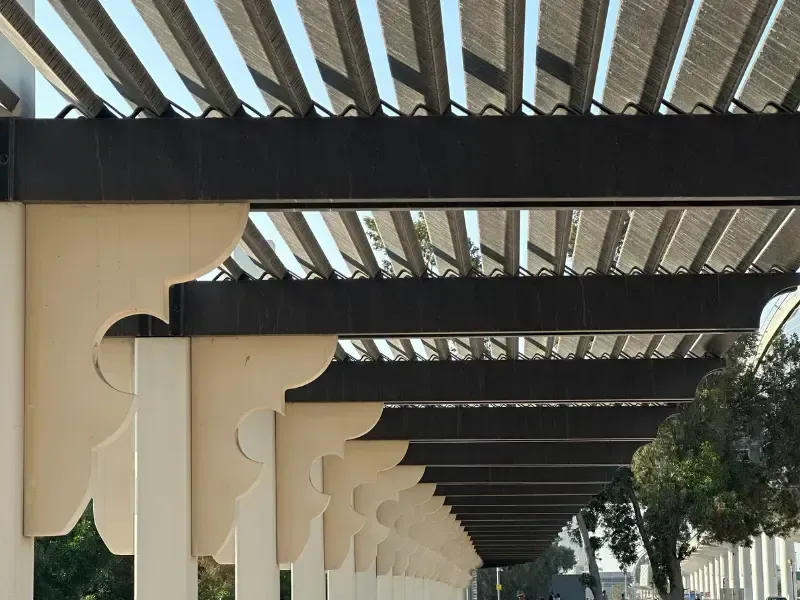
Do You Need a Permit for a Pergola in Smyrna, TN?
Yes, and the Town's wording leaves little room for interpretation. Smyrna lists site plan requirements for decks, porches, carports, storage buildings, pools, "or any other accessory structure" — which is a pergola. The first step isn't buying lumber, it's a site plan.
By Jeremy Bolton, Founder and Owner · Last updated August 14, 2026
Pergola, Gazebo, or Pavilion?
People use these interchangeably and then get quoted for three different structures. Here's the actual difference.
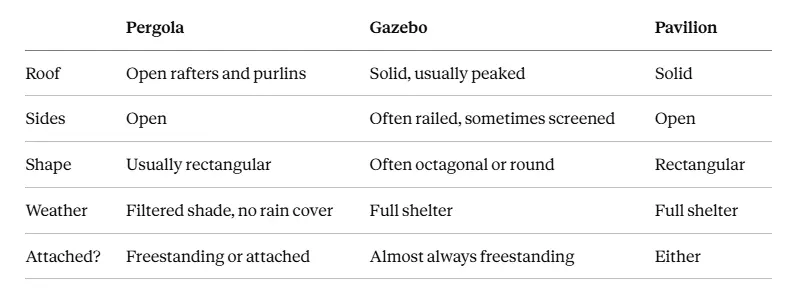
So what is the difference between a pergola and a gazebo comes down to the roof. A pergola's roof is a grid of spaced members — it filters light and lets rain through. A gazebo has a solid roof and usually a distinctive footprint, often octagonal. A pavilion sits between them: solid roof, open sides, rectangular.
That matters for cost and for permitting, because a solid roof adds dead load, wind uplift, and drainage that an open one doesn't. If what you actually want is rain protection, you want a patio cover rather than a pergola — and if you want more shade than a standard rafter spacing gives, our lattice patio cover guide covers how slat depth, spacing, and orientation change the coverage.
Permits and Site Plans in Smyrna
The Town of Smyrna is direct about this. Its Building Safety permits page states that anyone intending to erect a new structure must first obtain the appropriate permit, and that for accessory structures — the list runs room addition, deck, porch, garage, carport, storage building, pool, or any other accessory structure — the first step is to submit a site plan.
A pergola is an accessory structure. So the sequence is site plan, then permit, then build.
Two details worth knowing before you hire. Smyrna requires a Tennessee contractor's license, a certificate of insurance with workers' compensation or exemption in the same name as that license, and a Town business tax license or release form — all listed on the Building Safety page. The name-match requirement is the useful filter; mismatches are worth asking about.
And homeowner permits have a limit. The Town notes they may not be issued where the owner is doing the work for purposes of resale or lease — in those cases a licensed contractor has to pull the permit. If you're improving a rental or prepping to sell, that rules out the DIY route.
Setbacks vary by zoning district, and where the pergola sits relative to your property lines is decided at site plan stage. Any pergola contractors Rutherford County homeowners are comparing should be checking that before drawing anything.
Can a Pergola Be Attached to the House?
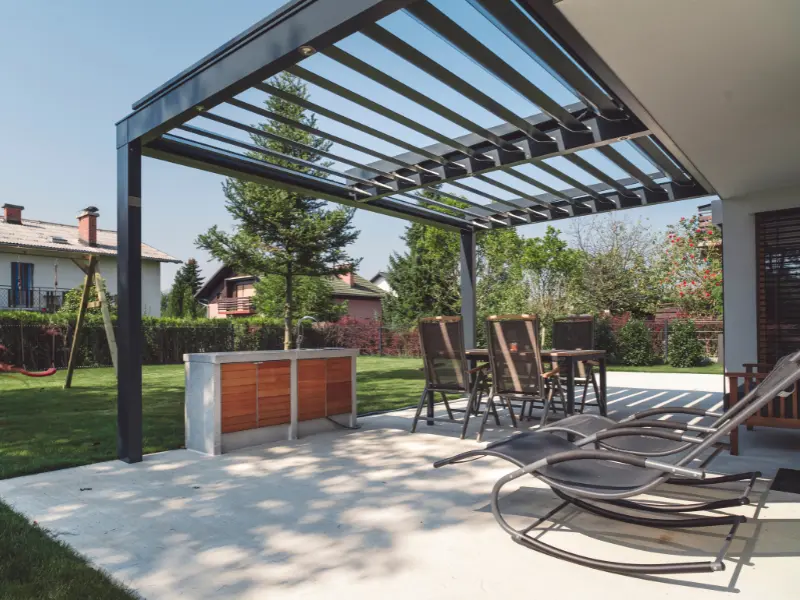
Yes, and it changes the job in three ways that are worth understanding before you choose.
The ledger. An attached pergola hangs one edge off a board bolted to the house, exactly like a deck. That connection carries real load, it has to go into the band board rather than siding, and it needs flashing above it directing water out. Get the flashing wrong and water runs behind the ledger into the wall — the same failure mode that takes down decks, and the reason our deck repair guide spends so long on ledgers.
Uplift. A pergola is mostly air, which sounds like it should reduce wind load. It does reduce the surface catching wind, but the rafters still generate uplift, and an attached structure transfers that into the house. Connections matter more than member size.
Placement. Attached means you step out under it, which is usually what people want. It also means the structure is fixed to the sunniest or shadiest wall you happen to have, rather than sited where the shade is actually needed.
Freestanding avoids all three and can be positioned wherever the yard works. It costs a little more in posts and footings and a little less in flashing and risk. We'll price both if you're undecided.
What Material Suits Tennessee?
Here's the thing about pergolas that doesn't apply to any other structure we build: it's almost entirely edges. A deck has a surface. A pergola is sticks — rafter ends, purlin ends, post tops, beam ends — and end grain absorbs water far faster than face grain does. Per square foot of structure, a pergola has more exposed end grain than anything else in your yard.
In Middle Tennessee humidity, that decides material and detailing more than looks do.
Cedar is the classic, and cedar pergola builders Middle Tennessee homeowners find will tell you it's beautiful — which it is. The caveat is that decay resistance lives in the heartwood, not the sapwood, and cedar is soft. It ages well when detailed properly and poorly when it isn't.
Pressure-treated pine is the value option and holds up well, provided the hardware is right for modern copper-based treatment. Hot-dip galvanized or stainless, never electroplated, and no aluminum in contact with the wood.
Aluminum and composite systems don't rot, don't need refinishing, and come in factory colors. They cost more upfront and look like what they are.
Whatever the material, the detailing is what lasts: post bases that hold the post off the concrete rather than in it, rafter ends cut at an angle so water runs off instead of sitting, post tops capped or sloped, and end grain sealed. Which pergola style is best for Tennessee climate is less about style than about whether the person building it cut the rafter tails at an angle.
Cost, Lifespan, and Install Time
How much does a custom pergola cost tracks footprint, span between posts, member sizes, material, attached versus freestanding, and footing depth. Longer clear spans need heavier beams, which drives cost faster than square footage does. Our wood deck installation guide covers footings and the shallow limestone that shows up across Rutherford County — the same test holes apply here. Estimates are free and financing is available.
On how long do pergolas last: aluminum and composite are effectively permanent with cleaning. Cedar and treated pine, properly detailed and refinished on a cycle, run decades. What ends them early is always the same two things — posts sitting in standing water at the base, and unsealed end grain at the tops and tails.
On timeline, most pergolas are a few days of build once footings have cured. The calendar is set by the site plan and permit rather than the carpentry, so start there.
Value, and Smyrna Yards
Do pergolas add home value in Tennessee? They add usable space more reliably than appraised value. Nobody appraises a pergola line-item. What it does is make a patio somewhere people actually sit in July, and outdoor living space shows well when a house is on the market — provided the structure looks intentional and matches the house rather than sitting beside it.
Across Smyrna the yard decides the design. The newer subdivisions off Sam Davis Road and toward Lee Victory sit on graded lots where a freestanding pergola over a patio works cleanly. Older properties along Old Nashville Highway have more mature canopy, so existing tree shade changes how much the structure needs to do. And smaller lots make setbacks the constraint before anything else does.
We build across Smyrna and Murfreesboro. Structures are on our pergola page and decks page, the full city list is on our locations page, and finished work is in the gallery. A backyard pergola Nashville TN homeowners commission works the same way, though Metro's permitting differs from Smyrna's.
If you've been searching custom pergola installation Smyrna TN, comparing the best custom pergola builders near Smyrna TN, or looking at top rated pergola designers in the Nashville area, ask one question first: have you looked at my setbacks? Everything downstream depends on it.
Frequently Asked Questions
1. Do I need a permit for a pergola in Smyrna TN?
Yes. The Town of Smyrna requires a permit to erect a new structure, and its accessory structure guidance covers room additions, decks, porches, garages, carports, storage buildings, pools, or any other accessory structure — which includes a pergola. The first step is submitting a site plan, since that's where setbacks and placement get resolved. Note also that homeowner permits may not be issued where the work is being done for resale or lease purposes; in those cases a licensed contractor must pull the permit.
2. How long does pergola installation take?
Most pergolas are a few days of build time once footings have cured. The calendar is usually driven by the administrative side rather than the carpentry — site plan preparation, permit issuance, and inspection scheduling. Larger structures, attached designs requiring a ledger and flashing detail at the house, and sites where footings hit rock all extend it. Plan on several weeks from first conversation to finished structure, with most of that before anyone arrives with lumber.
3. Can pergolas be attached to a house?
Yes. An attached pergola hangs one edge from a ledger board bolted to the house, which must be fastened into the band board rather than siding and flashed properly above so water is directed out rather than behind it. That connection also transfers wind uplift into the house, so the hardware matters more than the member sizes. Freestanding avoids the ledger entirely and can be positioned where the shade is actually wanted, at the cost of two additional posts and footings.
4. What is the best material for Tennessee pergolas?
It depends on how much maintenance you want. Cedar looks best and is the traditional choice, but its decay resistance is in the heartwood and it's a soft wood. Pressure-treated pine performs well and costs less, provided the hardware suits modern copper-based treatment — hot-dip galvanized or stainless, never electroplated, and no aluminum touching the wood. Aluminum and composite systems don't rot or need refinishing but cost more upfront. Detailing matters more than material: standoff post bases, angled rafter tails, capped post tops, sealed end grain.
5. Do pergolas add home value in Tennessee?
They add usable space more reliably than appraised value, since nothing appraises a pergola as a line item. The return is practical — a patio that's comfortable in July instead of empty — and presentational, because outdoor living space shows well to buyers. The distinction that matters at resale is whether the structure looks designed for the house. A pergola whose proportions, material, and finish match the property reads as part of it; a generic kit dropped on a patio reads as temporary.
Contact JB's Enclosures
JB's Enclosures 1349 Marymont Dr. Murfreesboro, TN 37129 Phone: (615) 713-7902 Veteran-owned, serving Smyrna including Lee Victory, Sam Davis Road, and Old Nashville Highway, plus Murfreesboro, Nashville, and Rutherford County.
Thinking about a pergola? Request a free on-site estimate or call (615) 713-7902, and we'll check your setbacks, price attached against freestanding, and handle the site plan.
