How Do You Know If a Deck Is Unsafe in Smyrna, TN?
Take a screwdriver into the yard and push it into the bottom of a post, then into the joist ends where they meet the house. If it sinks in, stop using the deck. That test tells you more than any look from the patio door, because the parts that fail first are the ones you can't see from above.
By Jeremy Bolton, Founder and Owner · Last updated August 13, 2026
Is Your Deck Safe to Use?
Four checks, in order of what actually hurts people.
Push on the guards. Hard, with your hip. Guards almost never fail by the rail breaking; they fail by the post pulling out of the framing. Any movement at a guard post base is a stop-using-it finding.
Probe the post bases. Where a post meets concrete or soil is where water sits. A screwdriver shouldn't sink in.
Look at where the deck meets the house. That connection carries most of the load and is the most common point of collapse. Look for rust streaks down the siding below it, gaps, or missing flashing.
Probe the joist ends. Same test. Joist ends sit against the ledger, water gets trapped in the joint, and they rot from the inside out.
Bounce and sway matter less than people think — some deflection is normal. Rust streaks are the tell, and the next section explains why. If any of those checks fails, keep people off it. Genuine emergency deck repair companies in the Nashville area will say the same before quoting anything.
What Actually Fails, and in What Order
Not everything on a deck is equally serious. This is the hierarchy we work through.
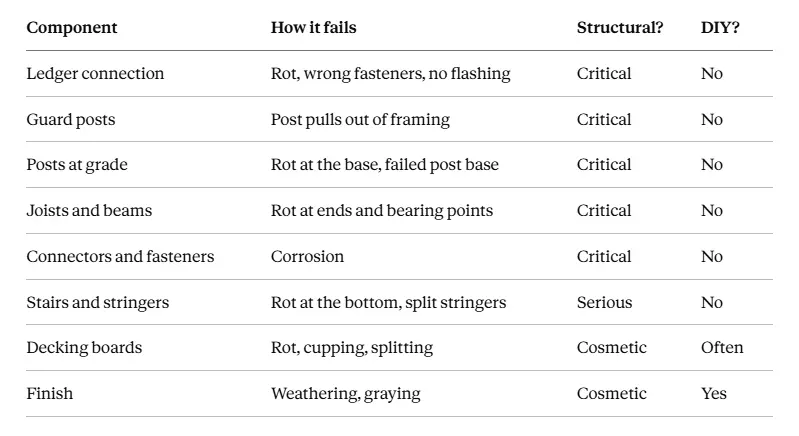
Notice the pattern: everything above the decking line is structural, and almost none of it is visible from standing on the deck. That's why a deck can look fine and be unsafe, and why deck repair contractors Rutherford County homeowners hire should be getting underneath rather than walking the surface.
The American Wood Council publishes a free prescriptive residential deck construction guide, DCA 6, setting out ledger, hanger, and post-to-beam details. It's the reference most inspectors work from.
The Fastener Problem Nobody Mentions
Here's the thing that surprises homeowners, and it's the real story in deck repair.
The wood usually isn't what fails first. The metal is.
Pressure-treated lumber changed around 2004. The old CCA treatment was phased out of residential use and replaced with ACQ and copper azole, which are copper-based and considerably more corrosive to steel. The American Wood Council puts it plainly in its guidance on fastener corrosion: connectors and fasteners exposed to the chemicals in ACQ, copper azole, or ACZA show higher rates of corrosion in accelerated testing than the same hardware exposed to CCA.
What that means in practice:
Fasteners in contact with treated wood need to be hot-dip galvanized to ASTM A153, stainless steel, silicon bronze, or copper. The code requirement sits at IRC R317.3.
Connectors — joist hangers, post bases, post caps — need G185 coating under ASTM A653, roughly 1.85 ounces of zinc per square foot.
Electroplated screws, and connectors marked G60 or G90, were designed for the old CCA. They will not hold up in ACQ. They're still sold, and they're still on plenty of decks.
Aluminum shouldn't be in direct contact with treated lumber at all.
So the failure sequence on a lot of decks built or repaired in the last twenty years is: wrong hardware, hangers rust from the inside, fasteners lose section, connections loosen, and then water gets into the joint and the wood rots. The rot is the symptom. The hardware was the cause.
Those rust streaks below a joist hanger aren't cosmetic. They're the hanger telling you what's happening on its hidden face.
This is also why a repair done with the wrong screws is worse than no repair. If you're getting quotes, ask what hardware they'll use and expect an answer with a coating spec in it.
Can Wood Deck Rot Be Repaired?
Can wood deck rot be repaired depends entirely on which piece has rotted.
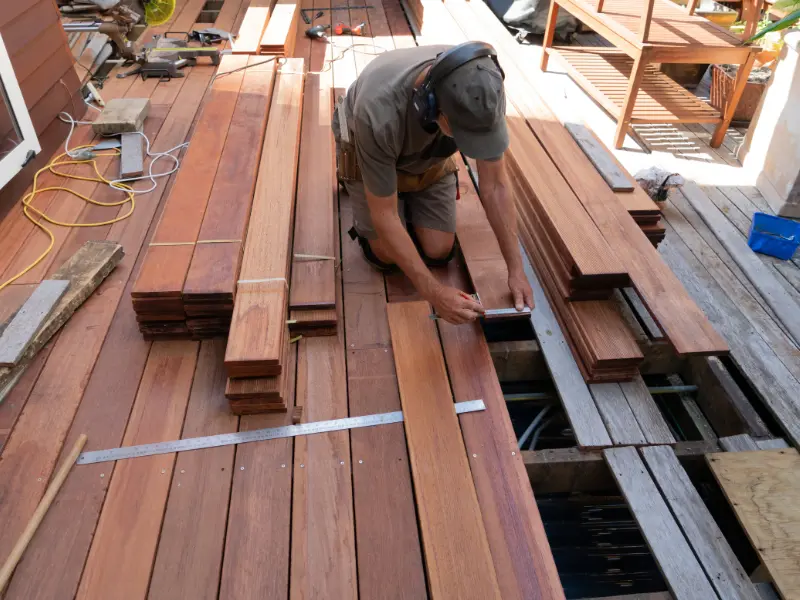
Decking boards: yes, individually. Two caveats. New treated lumber arrives wet and shrinks, so gaps change over the first season. And new boards won't match weathered gray for a year or two, which is why people often replace a whole run instead.
Joists, beams, posts: replaceable, but real work. A rotted joist end can sometimes be sistered or cut back and re-hung, depending on how much sound material remains. Posts get replaced with the deck temporarily supported.
The ledger: where the conversation changes. If the connection to the house has rotted, the siding comes off, the flashing was probably never right, and you're rebuilding a structural connection rather than patching one.
Wood filler and epoxy consolidants belong on trim. They have no place in a member carrying load. Anyone offering to fill a rotted joist isn't doing deck repair.
Repair or Replace, and What It Costs
The honest test for when should a deck be repaired vs replaced is what proportion of the structure is affected.
Repair makes sense when the framing is sound and problems are localized: some decking, a couple of joist ends, one post, stairs. Replace when rot appears in multiple framing members, when the hardware throughout is the wrong spec, when the ledger has failed, or when the deck was undersized to begin with — in that last case you're funding someone else's shortcuts.
Rough arithmetic: once repairs approach half the cost of a new deck, replacement is the better spend, because it resets the clock on everything rather than the parts you touched.
How much does deck repair cost turns on access, how much framing is involved, whether hardware is replaced throughout, and whether stairs and guards are in scope. Board replacement is the cheap end. Anything involving the ledger or multiple joists is a different order. We probe before quoting rather than pricing from photos, estimates are free, and financing is available. Our guide to wood deck installation covers material and footing decisions if replacement is where you land, and the multi-level deck guide covers guard and stair requirements.
Insurance, Refinishing, and Deck Vintage
On insurance: usually not. Policies respond to sudden accidental damage — a tree comes down on the deck, a storm takes a section off — and exclude rot, wear, and deferred maintenance, which is what most deck damage is. Check your declarations page, and photograph storm damage before touching anything.
On finish: deck refinishing Nashville TN homeowners book each spring is cleaning, brightening, and sealing, and it's preventive rather than cosmetic. Sealing slows moisture moving in and out of the board, which is what opens the checks and splits that hold water. Deck restoration Middle Tennessee weather demands is a cycle, not a one-time job. Our aluminum versus wood comparison covers that trade-off.
Deck age tells us more than address here, and it's worth knowing which cohort yours falls into:
Pre-2004. CCA-treated framing, which is less corrosive to hardware but the wood itself is now twenty-plus years old. Expect rot at posts and joist ends.
2004 to roughly 2010. The transition years, and the ones we find the most hardware problems in. ACQ lumber went in while plenty of jobs were still using CCA-era fasteners and G90 hangers. If your deck dates from here, the hardware is the first thing to check.
Post-2010. Generally correct hardware, so problems tend to be drainage, flashing, or a repair done with the wrong screws.
We work across Smyrna, Murfreesboro, and Nashville, with local service on our Smyrna page and the range of structures on our decks page. The full city list is on our locations page, completed work is in the gallery, and covering a deck is on our patio cover page.
If you've been searching deck repair Smyrna TN, comparing the best deck repair contractors near Smyrna TN, or wondering which contractor handles deck rot repair in Tennessee humidity, ask two questions. Will you get underneath and probe the framing? And what coating spec are the fasteners and hangers you'll use? Anyone who answers both has done this before.
Frequently Asked Questions
1. What causes deck damage in Tennessee humidity?
Moisture that can't escape, concentrated in predictable places. End grain wicks water, so cut ends of posts, joists, and stringers absorb far more than faces do. Horizontal surfaces hold water instead of shedding it. And anywhere two pieces are sandwiched without a drainage gap — joist end against ledger, post against beam — water sits indefinitely. Add copper-based treated lumber corroding the hardware in those same joints and you get the failure pattern we see most.
2. Can deck boards be replaced individually?
Yes, and it's routine. Boards come up and go back one at a time with the correct fasteners. Two things to expect: new pressure-treated lumber arrives wet and shrinks over the first season, so gaps change; and new boards won't match weathered gray for a year or two. That's why replacing a whole run often looks better than replacing one board in the middle of one. Structural members are a different matter and shouldn't be treated as swappable.
3. Is deck repair covered by homeowners insurance?
Usually not. Policies respond to sudden accidental damage such as a tree falling on the deck or storm damage taking a section off, and they generally exclude rot, wear, and deferred maintenance — which describes the great majority of deck damage. Check your declarations page rather than assuming either way. If storm damage does occur, photograph everything before removing anything, since cleanup destroys the evidence an adjuster needs.
4. How long does deck repair take?
Board replacement on a straightforward deck is often a day. Replacing joist ends, a post, or rebuilding stairs runs two to four days depending on how much temporary support is needed. Ledger work takes longer because siding comes off and flashing has to go back correctly. Hardware replacement throughout a deck is labor-heavy rather than material-heavy. Refinishing needs dry weather and a couple of days for cleaning, drying, and sealing.
5. How do I know if my deck is unsafe to use?
Four checks. Push hard on the guards — any movement at the base of a guard post means stop using it. Probe the post bases with a screwdriver; it shouldn't sink in. Look where the deck attaches to the house for rust streaks on the siding, gaps, or missing flashing, since that connection is the most common collapse point. Probe the joist ends where they meet the ledger. Rust streaks below joist hangers are a warning that the hardware is corroding on its hidden face.
Contact JB's Enclosures
JB's Enclosures 1349 Marymont Dr. Murfreesboro, TN 37129 Phone: (615) 713-7902 Veteran-owned, serving Smyrna, Murfreesboro, Nashville, and Rutherford County.
Probed something soft, or seen rust streaks on your siding? Request a free on-site estimate or call (615) 713-7902, and we'll get underneath, probe the framing, and tell you what's structural and what's cosmetic.
