What Frame Do Deck Builders Use for Composite?
A tighter one than most older decks have. Composite decking isn't structural — the frame does all the work — and nearly every brand caps joist spacing at 16 inches on centre, dropping to 12 for diagonal layouts. If your existing deck was framed at 24, you can't simply lay composite over it.
By Jeremy Bolton, Founder and Owner · Last updated August 25, 2026
Composite Is a Surface, Not a Structure
This is the part that surprises people who assume composite is simply wood that lasts longer.
Composite boards flex more than timber and expand and contract more with temperature, so manufacturers publish framing requirements that are tighter than what wood decking tolerates. Trex sets it out in its own joist installation guidance: no more than 16 inches on centre for standard installations, and 12 inches where boards run diagonally. Most major brands land in the same place.
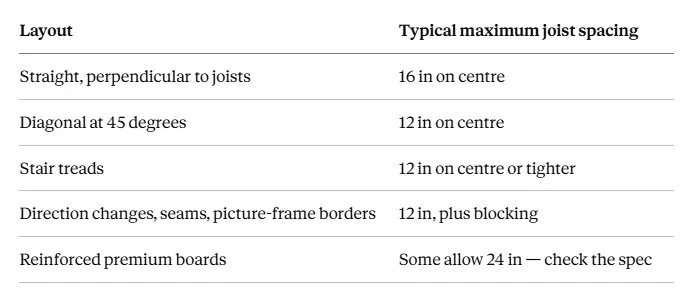
Re-decking an older frame often means adding joists. Plenty of decks built with thick timber decking were framed at 24 inches on centre because the boards could span it. Composite can't. Bringing that frame up to 16 means sistering in or installing additional joists — real work, real cost, and much better identified at quote stage than halfway through a tear-off.
Wider spacing doesn't just feel bouncy, it voids the warranty. Manufacturers treat their framing spec as a condition of coverage. A deck built at 24 inches with composite on top has no warranty behind it, whatever the brochure said about twenty-five years.
Patterns cost more than they look. Diagonal boards, picture-frame borders, and inlays all demand 12-inch spacing and blocking under every seam and direction change. That's a framing cost, not a decking cost, and it's why two decks of identical square footage can differ substantially. Anyone asking which builder handles luxury decks in Nashville area work should be pricing the frame for the pattern, not the pattern for the frame.
What Is the Best Deck Material for Tennessee Humidity?
There isn't one winner, and the honest comparison includes a drawback composite marketing tends to skip.
Pressure-treated pine is the value option and performs well here provided the hardware suits modern copper-based treatment. It needs refinishing on a cycle.
Cedar looks best and costs more, with decay resistance living in the heartwood rather than the sapwood. Our Smyrna wood deck guide works through species selection and ground-contact framing properly.
Wood-plastic composite doesn't rot and needs no refinishing. Uncapped first-generation boards can stain and grow mildew; capped boards carry a polymer shell that resists both. This is the honest caveat for a Middle Tennessee summer: composite runs hotter underfoot than wood in direct sun, and dark colours run hottest. On a west-facing deck with no shade, that matters more than the maintenance saving.
PVC is fully synthetic with no organic content, so there's nothing for mildew to feed on, and it's lighter and cooler than dark composite. It costs the most and looks the least like timber.
So what is the best deck material for Tennessee climate depends on shade and use. Full sun and barefoot traffic argues for lighter-coloured composite, PVC, or wood. Shade and low maintenance argues for capped composite. A composite deck installation Nashville area homeowners commission for a shaded north-facing space is a different recommendation from one baking on a west elevation — and if heat is the concern, a patio cover or screen room does more for usability than any board choice.
How Long Does a Wood Deck Last in Middle Tennessee?
Longer than people expect if the details are right, and much shorter if they aren't.
Properly built and maintained, treated pine gives decades. What ends decks early isn't the decking — it's the connections and the places water sits. Posts set into concrete rather than on standoff bases. Unsealed end grain at cut joists and rails. A ledger without flashing. And fasteners that were never rated for modern treated lumber.
That last one dates a specific batch of decks and it's covered in our deck repair guide, which also has the safety self-check worth running on any deck over ten years old.
Composite outlasts wood on the surface. Note that its frame is still timber, so the frame's lifespan governs the deck's — which is another argument for getting the framing right rather than spending the budget on boards.
Permits in Franklin
Yes, you need one. Franklin requires a building permit for new construction and additions, with plans through the City's electronic review system — details on its residential construction page.
Two Franklin points that bite specifically on decks. A deck may encroach into a rear setback only if it isn't covered — so if a roof might follow later, that decision belongs at design stage, not afterwards. And property inside a Historic Preservation Overlay needs the Historic Preservation Planner contacted before any permit issues.
Guard and stair requirements are where inspections most often fail. Our multi level deck guide covers the height thresholds that decide when a guard becomes mandatory, and our Franklin screen room guide covers the permit process and who is required to pull it.
Cost and Timeline
How much does a deck cost in Tennessee turns on footprint, height above grade, framing complexity, decking material, guard and stair count, and footing conditions. Two things move it more than square footage: height, since taller means longer posts and bigger footings, and pattern, for the framing reasons above.
Any deck contractors Williamson County TN homeowners compare should be quoting the frame explicitly — joist spacing, blocking, hardware, and footing depth. A quote that names a decking brand but not a joist spacing is describing the surface and guessing the rest.
How long does deck construction take: typically one to two weeks of build for a straightforward deck once footings have cured, longer for multiple levels, patterns, or difficult access. The calendar is usually set by permit review and inspection scheduling rather than the carpentry. Franklin's rolling terrain and clay soils mean footing depth varies, so we dig test holes before quoting. Estimates are free and financing is available.
Value in Williamson County
Do decks add home value in Williamson County? They add usable space reliably and appraised value less predictably — nothing appraises a deck as a line item.
What matters in this market is that it reads as designed. Williamson County housing is finished to a high standard, and a deck whose proportions, railing detail, and material relate to the house supports the property. A generic rectangle bolted to the back wall reads as an afterthought and can work against you at showing. That's most of what separates the top rated deck contractors in Williamson County from the rest, and it's why the framing conversation matters — a well-built frame lets you do the design, while a marginal one limits you to the simplest layout.
We build across Franklin, Cool Springs, and Westhaven plus Brentwood, Nolensville, and the wider Nashville area. The range is on our decks page, the full city list on our locations page, and finished work in the gallery. Custom deck builders Middle Tennessee homeowners hire should all be willing to show you a frame mid-build, not just a finished surface.
If you've been searching deck builders Franklin TN, or comparing the best deck builders near Franklin TN, ask one question first: what joist spacing are you framing at, and does it suit the decking I've chosen?
Frequently Asked Questions
1. How much does a new deck cost in Franklin TN?
Cost turns on footprint, height above grade, framing complexity, decking material, the number of guards and stair flights, and footing conditions. Two factors move it more than square footage: height, since taller decks need longer posts and larger footings, and board pattern, because diagonal layouts and picture-frame borders require 12-inch joist spacing plus blocking rather than the standard 16. Franklin's clay soils and rolling terrain mean footing depth varies, so we dig test holes before quoting. Estimates are free.
2. Do I need a permit for a deck in Franklin Tennessee?
Yes. Franklin requires a building permit for new construction and additions, with plans submitted through the City's electronic review system. Two local points matter for decks specifically: a deck may encroach into a rear setback only if it is not covered, so if you might add a roof later that decision belongs at design stage; and property inside a Historic Preservation Overlay requires contacting the Historic Preservation Planner before any permit can be issued. Guard and stair geometry is where inspections most often fail.
3. What is the best deck material for Tennessee humidity?
It depends on shade and use. Capped composite resists rot, staining and mildew and needs no refinishing, but runs hotter underfoot than wood in direct sun, with dark colours worst. PVC has no organic content for mildew to feed on and runs cooler than dark composite, at the highest price. Cedar looks best with decay resistance in the heartwood. Treated pine is the value choice and performs well provided hardware suits modern copper-based treatment. Full sun and bare feet argue for lighter colours or wood.
4. How long does a wood deck last in Middle Tennessee?
Decades when built properly, far less when it isn't — and the difference is almost never the decking. What ends decks early is the connections and the places water sits: posts set into concrete rather than on standoff bases, unsealed end grain at cut joists and rails, a ledger without flashing above it, and fasteners never rated for modern copper-based treated lumber. Worth noting that composite decks have timber frames too, so the frame governs the deck's life regardless of the surface.
5. Do decks add home value in Williamson County?
They add usable space reliably and appraised value less predictably, since nothing appraises a deck as a separate line item. In this market the distinction that matters is whether it looks designed for the house. Williamson County housing is finished to a high standard, so a deck whose proportions, railing detail and material relate to the property supports it at showing, while a generic rectangle bolted to the rear wall reads as an afterthought. A well-built frame is what makes the better design possible.
Contact JB's Enclosures
JB's Enclosures 1349 Marymont Dr. Murfreesboro, TN 37129 Phone: (615) 713-7902 Veteran-owned, serving Franklin and Williamson County including Cool Springs and Westhaven, plus Brentwood, Nolensville, and the Nashville area.
Thinking about composite over an existing frame? Request a free on-site estimate or call (615) 713-7902, and we'll measure your joist spacing before anyone talks about boards.
