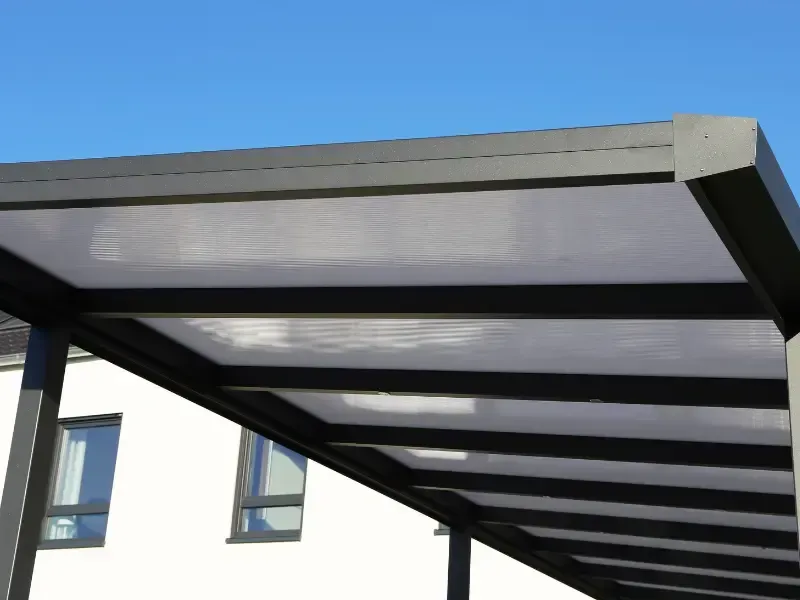
What Is an Aluminum Carport in Nashville, and Does It Rust?
An aluminum carport is a vehicle shelter built from extruded aluminum framing and panels. It will not rust — rust is iron oxide and aluminum contains no iron — but it can corrode galvanically where it meets the wrong fastener. JB's Enclosures installs aluminum carports in Nashville, and the fastener spec matters more than the alloy.
By Jeremy Bolton, Founder and Owner · Last updated August 11, 2026
What Is an Aluminum Carport?
The answer to what is an aluminum carport is a shelter framed in extruded aluminum sections rather than formed steel tubing, roofed with aluminum panels — commonly a pan or W-pan profile, or an insulated foam-core panel.
That last detail is worth knowing, because it means an aluminum carport usually comes from the same product family as an aluminum patio cover. Same extrusions, same panel systems, same factory finishes. Two practical consequences follow. If you already have an aluminum patio cover, a carport can be specified to match it in colour and profile rather than sitting beside it as a visibly different structure. And if you are weighing materials for a patio cover at the same time, our aluminum versus wood patio cover guide covers that comparison in this climate.
An aluminum car shelter also arrives with a finish already on it. Where steel kits are commonly bare galvanized or galvalume, aluminum systems are typically supplied in factory-applied colours, which matters in neighbourhoods where a bare metal structure would not pass design review.
If the underlying question is covered parking versus an enclosed building, our carport versus garage comparison is the place to start.
Do Aluminum Carports Rust?
No — and the reason is worth stating properly, because "rust-proof" gets used loosely.
Rust is specifically iron oxide. It forms on iron and steel, it is porous, and it flakes away, which continuously exposes fresh metal underneath. That is why rust spreads: the corrosion product does not protect the metal.
Aluminum forms aluminum oxide instead, and that layer behaves in the opposite way. It is dense, it adheres tightly, and it is self-limiting — once formed, it slows further oxidation rather than accelerating it. Scratch aluminum and the exposed surface re-oxidizes and seals itself. Scratch painted steel and you have started a problem.
So a lightweight aluminum carport does not develop the creeping rust you see on older steel structures, and it does not stain siding or driveways with rust runoff. That is a genuine advantage in Middle Tennessee humidity.
What aluminum can do is corrode by other mechanisms — chiefly pitting, and galvanic attack when it is coupled to the wrong metal. Corrosion resistant is not corrosion immune, and the next section is where the real risk lives.
The Real Corrosion Risk Is the Fasteners
This is the part almost nobody explains, and it is the difference between a structure that lasts thirty years and one that develops problems at every connection.
Aluminum sits toward the active end of the galvanic series — more active than steel, stainless steel, copper, and brass. When two dissimilar metals are electrically connected with moisture present, the more active one corrodes preferentially. Aluminum is usually the one that gives way, which means every fastener, bracket, and bearing point where aluminum meets another metal is a potential corrosion site.
Three things govern how bad it gets: how far apart the two metals sit in the galvanic series, how conductive the moisture between them is, and — the one that is genuinely counterintuitive — the area ratio between the two metals.
That area ratio is the practically useful part. A small stainless fastener through a large aluminum member is comparatively benign, because the corrosion is spread across a large aluminum area.
So a proper aluminum carport install attends to four details:
Fastener selection. Zinc-coated steel fasteners sit close enough to aluminum in the series to be acceptable. Bare copper and brass should never contact aluminum. Nickel-plated steel is a poor choice.
Isolation at dissimilar-metal joints. Nylon, EPDM, or PTFE washers, gaskets, and bushings break the electrical path where aluminum bears on steel.
Sealant at penetrations, which keeps the electrolyte — water — out of the joint in the first place.
Drainage in the design, so water does not stand in channels or at connections.
None of that is expensive. It is specification and workmanship, and it is invisible on the day of installation, which is exactly why it gets skipped. If you are comparing the best aluminum carport installers in nashville, ask what fasteners they use and whether they isolate at steel connections. An installer who has a ready answer has thought about the next twenty years.
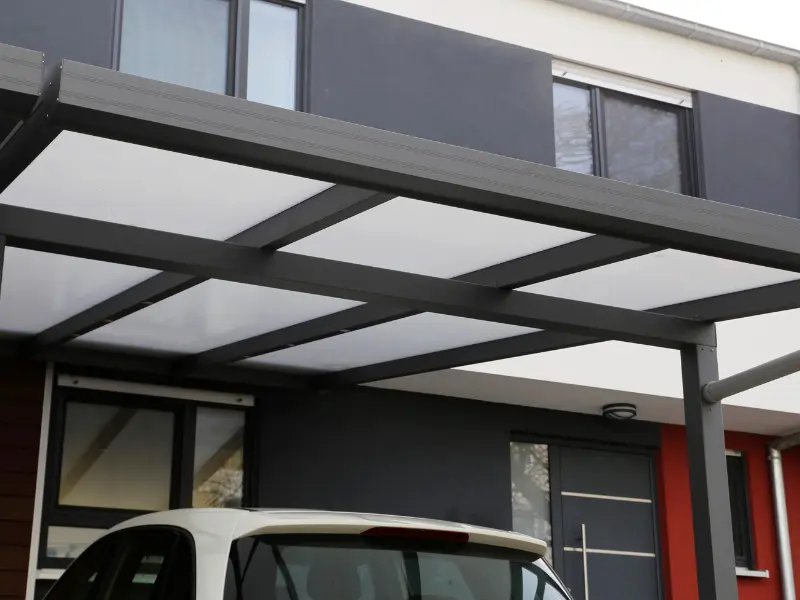
Aluminum vs Steel: The Honest Trade-Off
The aluminum vs steel carport difference comes down to a genuine engineering trade rather than one being better.
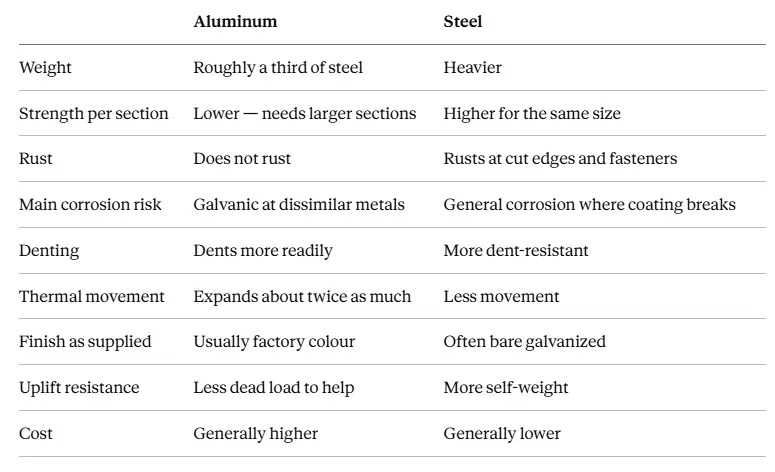
The row that drives the others is strength per section. Aluminum is far lighter but also less stiff and less strong than steel for the same dimensions, so an aluminum structure carrying the same load needs visibly larger sections. That is not a flaw — it is the design consequence. What it means practically is that a cheap aluminum kit with slender members is not the equal of a steel one with slender members, and comparing carports on price alone across materials tells you very little.
For the steel side in detail — gauge, coatings, certification, and anchoring — our metal carports guide covers it, and that is the fuller aluminum vs steel carport comparison. The short version of aluminum carport benefits and drawbacks: it wins on corrosion, weight, and finish, and it gives ground on strength per section, denting, and price.
Why Lighter Means Anchoring Matters More
This follows directly from the weight row, and it is the most important safety consequence of choosing aluminum.
A carport is open on all sides, so wind gets under the roof plane and pushes up. The structure resists that uplift through its anchors and, to a lesser degree, its own weight. Aluminum weighs roughly a third of what equivalent steel does — which means there is materially less dead load helping to hold it down, and the anchors are doing proportionally more of the work.
So anchoring on an aluminum carport is not a detail to economise on. Anchors must be sized for tension rather than for holding a heavy object in place, base plates need adequate edge distance from any slab perimeter so the concrete does not spall, and an existing patio slab's thickness is an unknown until it is drilled. Where the structure is permitted, expect engineered footings rather than surface anchors into whatever slab is already there.
Thermal Movement and Denting
Two aluminum-specific behaviours worth designing around rather than discovering.
Thermal movement. Aluminum expands and contracts roughly twice as much as steel over the same temperature change, and Middle Tennessee gives it plenty of range between a February morning and an August afternoon. On a long run of panel or a long beam, that movement has to be allowed for — slotted holes, appropriate fastener torque, and panel details that let sections move. Pin an aluminum panel rigidly at both ends and it will oil-can, and it will work its fasteners loose over several seasons.
Denting. Aluminum is softer than steel, so it dents more readily — from hail, from a thrown ball, from a ladder set against it. Nashville gets hail, and a carport bought partly to protect a vehicle from hail will itself carry the marks. Heavier gauge helps and nothing eliminates it.
Cost, Lifespan, Permits, and Where Aluminum Fits
On budget, how much does an aluminum carport cost is driven by footprint, span between posts, section sizes, panel type — plain or insulated — finish, and site preparation. Aluminum generally sits above steel for a comparable structure, because the material costs more and the sections need to be larger. Insulated panels cost more again and are worth it where the carport doubles as covered outdoor space. Levelling and any slab are separate from the structure price. We quote from the site, estimates are free, and financing is available.
On lifespan, a well-specified aluminum structure with correct fasteners and isolation at dissimilar-metal joints is a multi-decade proposition, and the factory finish rather than the metal is usually what ages first.
On permits: Metro Nashville treats a detached carport as an accessory structure requiring a permit through the Department of Codes and Building Safety, with carports named explicitly in its accessory structure permitting instructions. Material makes no difference to that. What does matter is footprint and placement, and our custom carports guide covers the setback thresholds that decide what fits on your lot.
Aluminum earns its premium in three situations. Attached carports, where lower dead load on the connection to the house is a genuine advantage. Properties with existing aluminum patio covers, where matching profile and colour makes the addition read as part of the house. And HOA or design-review neighbourhoods, where a factory-finished structure passes where bare galvanized steel does not — relevant across much of Davidson County, including the newer subdivisions and the conservation overlay districts.
We install across the area — see our carports page for the range, our Nashville page for local service, and Brentwood. The full list is on our locations page, completed builds are in our gallery, related structures on our patio cover and pergola pages.
If you have been searching aluminum carports Nashville, the summary is this: it will not rust, the fasteners are where corrosion actually happens, and because it is light the anchoring matters more rather than less.
Frequently Asked Questions
1. How much do aluminum carports cost in Nashville?
Cost is driven by footprint, span between posts, section sizes, panel type — plain or insulated — finish, and site preparation. Aluminum generally sits above steel for a comparable structure, because the material costs more and sections must be larger to carry the same load. Insulated panels add cost and are worth considering where the carport doubles as covered outdoor space.
2. How long do aluminum carports last?
A well-specified aluminum structure is a multi-decade proposition, and the factory finish usually ages before the metal does. What determines the outcome is the connections rather than the members: correct fastener selection, isolation where aluminum bears on steel, sealed penetrations, and drainage that keeps water from standing in channels.
3. Are aluminum carports better than steel?
Neither is better outright. Aluminum wins on corrosion resistance, weight, and factory finish, and it does not stain siding with rust runoff. Steel wins on strength per section, dent resistance, thermal stability, and price. The trade that drives the rest is strength: aluminum needs visibly larger sections to carry the same load, so comparing carports across materials on price alone is misleading.
4. Do aluminum carports rust?
No. Rust is iron oxide and aluminum contains no iron. Aluminum forms aluminum oxide instead, which is dense, tightly adhering, and self-limiting — so a scratch re-seals rather than spreading, unlike rust on steel which flakes and exposes fresh metal. Aluminum can still corrode by other mechanisms, principally pitting and galvanic attack where it contacts a dissimilar metal such as steel, copper, or brass in the presence of moisture.
5. Do I need a permit for an aluminum carport in Nashville?
Yes, and the material makes no difference. Metro Nashville treats a detached carport as an accessory structure requiring a permit through the Department of Codes and Building Safety, with carports named explicitly in its accessory structure permitting instructions. Zoning examiners review use, setback, footprint, and height against your parcel's zoning.
Contact JB's Enclosures
JB's Enclosures 1349 Marymont Dr. Murfreesboro, TN 37129 Phone: (615) 713-7902 Veteran-owned, serving Nashville including Lakewood, Talbot's Corner, Parkwood, and Hermitage, plus Brentwood and Middle Tennessee.
Weighing aluminum against steel? Request a free on-site estimate or call (615) 713-7902, and we will tell you which suits your lot, your lot's setbacks, and the way the structure has to be anchored.
