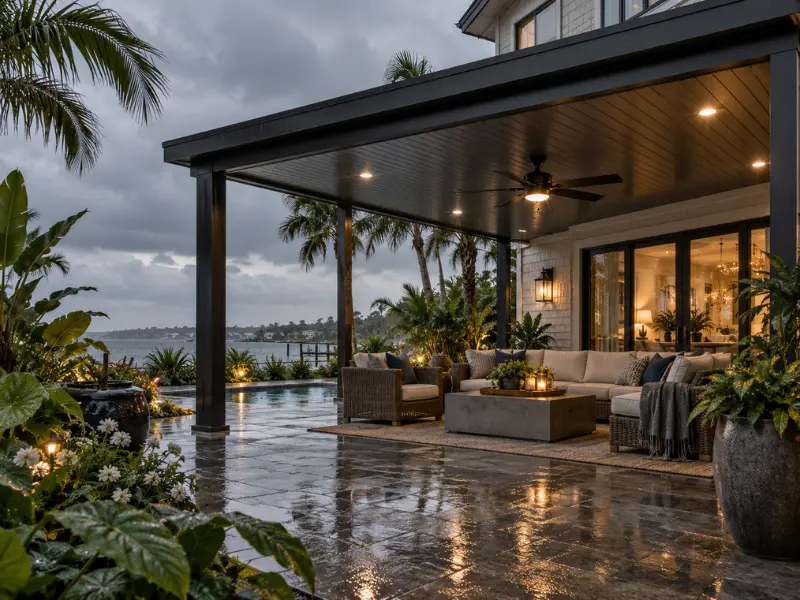
How Do Insulated Patio Covers Handle Fan Wiring in Franklin?
Cleanly, because the panel itself is built to carry it. In an insulated patio cover, rigid foam sits between two aluminum skins. That cavity does double duty. It blocks heat. It also hides the wire run for a fan or light, instead of leaving it exposed on the surface. Our own installs in Franklin usually start with that question, not the cost question.
By Jeremy Bolton, Founder and Owner · Last updated September 28, 2026
How Insulated Patio Covers Differ From Standard Panels
One extra layer, and it changes three things at once.
A standard aluminum patio cover panel is a single skin. An insulated panel is two aluminum skins laminated to roughly three inches of rigid foam core in between. That core does three jobs. It blocks radiant heat before it reaches the space underneath. It dampens the sound of rain hitting the roof. The foam absorbs the impact instead of transmitting it straight through metal. And it creates a hollow cavity running the length of the panel. That cavity is exactly where wiring for a fan or light gets routed.
Our full aluminum patio cover guide covers the material choice itself in more depth. This piece is about what the insulated build specifically makes possible.
Why Insulated Panels Make Clean Fan and Light Wiring Possible
A single-skin panel has nowhere to hide a wire. An insulated one does.
An insulated roof panel patio cover Franklin homeowners choose for a ceiling fan typically runs the wiring through a beam built into the panel structure. It's concealed inside the foam-and-aluminum sandwich. It isn't surface-mounted or strapped along the underside. That's a real installation difference, not a cosmetic one. Surface-mounted wiring on a non-insulated cover is visible. It's more exposed to weather at the fixture penetration. And it's harder to keep looking finished.
An insulated patio cover with ceiling fan wiring Franklin buyers ask for is planned before installation starts, not added after. Fixture locations get decided during layout, so the internal wiring lines up. That's a conversation worth having at the estimate stage, before the roof panels go up rather than after.
Code matters here too, not just wiring convenience. A covered patio is typically treated as a damp location under the electrical code, so the fan or light fixture itself has to carry a damp-rated or wet-rated listing, not just any indoor fixture. Tennessee enforces the National Electrical Code statewide, currently the 2017 edition as adopted by the State Fire Marshal's Office. We plan fixture selection around that requirement from the start, so you're not stuck swapping a fixture after inspection.
Heaters follow the same logic on a larger scale. A ceiling-mounted patio heater draws more power than a fan or light, so the circuit needs to be sized correctly from the start. That's another reason to settle fixture locations at the estimate rather than after the fact — running a heavier circuit through an already-finished panel is a much bigger job than planning for it up front.
Does Panel Thickness Affect Fan Clearance?
Sometimes, and it's worth measuring before you commit.
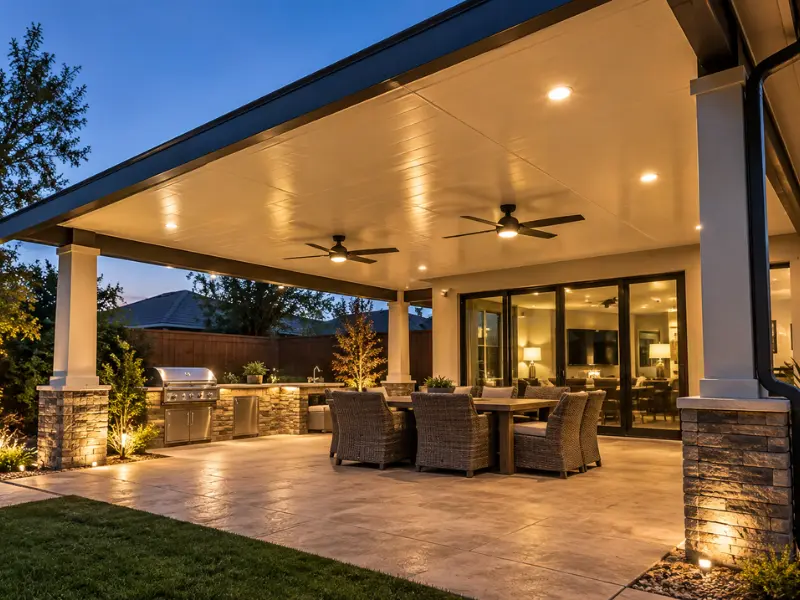
Insulated panels run roughly three inches thick, versus a fraction of an inch for a single-skin panel. On an attached cover with limited clearance between the house eave and the desired roofline, that extra thickness can change the pitch or the finished ceiling height. A ceiling fan needs room to hang and turn below the panel, so this matters more when a fan is part of the plan. It's rarely a dealbreaker, but check the clearance at the estimate, especially on a lower eave line.
Who Installs Insulated Patio Covers in Franklin?
Ask any installer two questions: have they wired a fan through an insulated panel before, and do they plan fixture locations at the estimate, before the panels are ordered?
Panel layout and fixture placement should be decided together. Franklin's rear-setback permit rule for covered structures applies regardless of panel type, and our Franklin patio cover permit guide covers it in full. An insulated patio cover installer Franklin homeowners can rely on should walk the wiring plan with you before anything gets ordered. Panel layout and fixture placement get decided together, not in sequence. Franklin's rear-setback permit rule for covered structures still applies regardless of panel type. Our Franklin patio cover permit guide covers that requirement in full if you haven't already read it.
JB's Enclosures is veteran-owned with 20+ years building custom aluminum patio covers, screen rooms, decks, and carports across Franklin, Cool Springs, Westhaven, Brentwood, Nolensville, and the wider Nashville area. Anyone comparing the best insulated patio cover installer near Franklin should ask both questions above before comparing quotes. See our patio cover page and completed local builds on our Franklin service area page.
We build both insulated and standard covers across Franklin, and we'll walk both options during the site visit rather than default to one. Bring a rough idea of what you want mounted in the ceiling, even if it's just "maybe a fan someday," since that single detail changes how the panel layout gets planned from the first sketch.
Frequently Asked Questions
1. How much do insulated patio covers cost in Franklin?
Insulated panels cost more than standard single-skin panels. Most of that difference comes from the extra material and, often, the fan or light wiring that goes with them. Beyond panel type, the usual factors drive price: covered square footage, whether the cover attaches to the house or stands freestanding, footing depth, and any electrical for fans or lighting. We price from on-site measurements rather than a flat rate per square foot.
2. What is the difference between insulated and standard patio covers?
A standard panel is a single sheet of aluminum. An insulated panel laminates two aluminum skins around roughly three inches of rigid foam core. That core blocks radiant heat, dampens rain noise, and creates a concealed cavity for fan or light wiring. A standard panel costs less upfront. It also runs hotter and louder in rain, and any wiring has to be surface-mounted instead of hidden.
3. Do insulated covers make the space cooler and quieter in rain?
Yes, on both counts, and it's the same foam core doing the work. The core interrupts radiant heat transfer, so the panel doesn't re-radiate warmth into the space the way a standard aluminum panel does. It also absorbs the impact of rain instead of transmitting the sound straight through to the framing. That's the difference between a noticeable patter and a loud drum roll during a Tennessee downpour.
4. Can lighting, fans or heaters be built into an insulated cover?
Yes, and insulated panels are built for exactly this. The cavity inside the panel gives wiring a concealed path to a fan mount, a light fixture, or a heater location, rather than running it exposed along the surface. The key is deciding fixture placement during the estimate and layout stage. Retrofitting wiring into an already-installed panel is far more limited than planning it in from the start.
5. Is an insulated cover worth the extra cost?
For most Franklin homeowners planning to actually use the space through a Tennessee summer, yes. The upgrade pays off most clearly if you want a ceiling fan, light, or heater built in cleanly, or if the patio sits somewhere that gets full afternoon sun. If the cover is mostly decorative, or the space already stays shaded, a standard panel may be enough. We'll walk both options at the estimate, so you're pricing against your actual use rather than just the panel spec.
Contact JB's Enclosures
JB's Enclosures 1349 Marymont Dr., Murfreesboro, TN 37129 Phone: (615) 713-7902 Veteran-owned, serving Franklin, Cool Springs, Westhaven, Brentwood, and Nolensville, plus Murfreesboro, Smyrna, and the wider Nashville area.
Planning a fan or light into your patio cover? Request a free on-site estimate or call (615) 713-7902, and we'll plan the wiring into the layout from the start.
