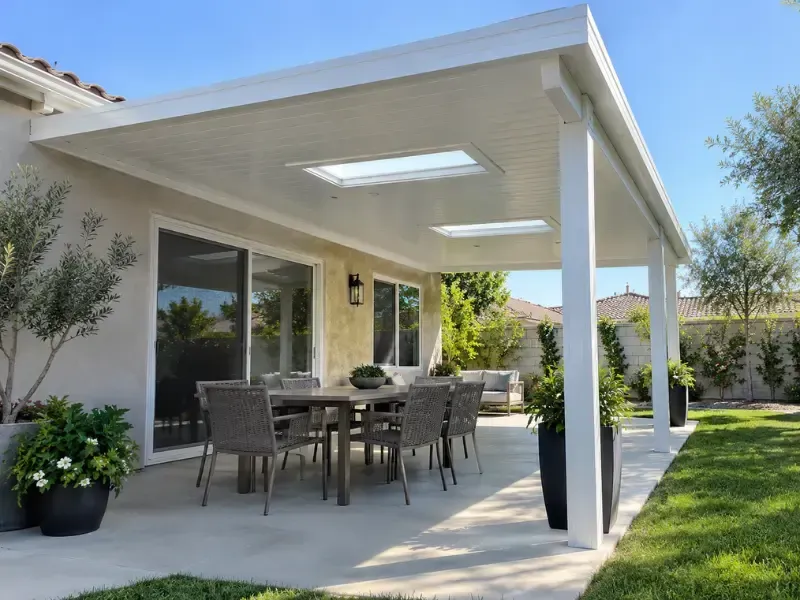
Why Do Aluminum Patio Covers Suit Tennessee?
Because the two things that kill outdoor structures here are moisture and maintenance, and aluminum is indifferent to the first while eliminating most of the second. It does have one behavior worth designing around, though, and almost nobody mentions it in a sales conversation.
By Jeremy Bolton, Founder and Owner · Last updated September 16, 2026
What Does Aluminum Actually Do Differently?
Three things, and the first is the one that matters in a humid climate.
It cannot rust. Rust is iron oxide, and there is no iron in aluminum. What forms instead is a thin aluminum oxide layer that seals the surface rather than flaking off it, so a scratch stops rather than spreads. On a structure sitting in Middle Tennessee humidity for twenty years, that difference compounds.
It does not rot, warp or feed anything. No refinishing cycle, no end grain to seal, nothing for mildew to live on. Timber can look better and it needs an owner willing to maintain it.
It is light for its strength, which means less structure underneath and smaller footings for the same covered area.
The trade-off is that aluminium is softer than steel, so it dents where steel would resist, and it needs more section to span the same distance. For a patio cover that rarely matters. For something taking impact it can.
Are aluminum patio covers better than wood? Not universally, and the honest comparison sits in our live aluminium versus wood guide rather than being reargued here.
Why Does Thermal Movement Matter?
This is the behaviour nobody mentions, and it is the reason two identical-looking covers can perform differently after five summers.
Aluminium expands and contracts appreciably more than steel or timber across a temperature range. Smyrna sees hard freezes in January and roof-surface temperatures in July that are far above air temperature, so a long aluminium span moves noticeably between those extremes. That movement is normal and unavoidable. What matters is whether the structure was built to accommodate it.
Done properly, the fixings allow the panels to move. Done poorly, the movement has nowhere to go, and it shows up three ways: fastener holes elongating over repeated cycles until fixings loosen, panels oil-canning into a visible ripple, and ticking or popping noises as the structure heats and cools.
So on any long run, ask how the fixings handle expansion. It is a short question, and the answer separates an installer who has thought about the material from one fitting a kit.
The same logic applies at the ledger where an attached cover meets the house. Two different materials, two different rates of movement, one connection between them.
What Does an Insulated Panel Change?
Four things, and only one of them is insulation in the sense people expect.
An insulated panel is a foam core between two aluminium skins. Because that sandwich is structural, it spans post to post without framing underneath, which is why an insulated cover looks cleaner from below than a single-skin roof on joists.
Radiant heat is the obvious gain. Single-skin aluminium heats through and radiates down onto the space below. The foam core stops most of that.
Rain noise is the underrated one. A single-skin roof in a Tennessee thunderstorm is loud enough to end a conversation. Insulated panels reduce it substantially.
Condensation largely stops being an issue, because the underside no longer sits at the temperature of the outside air.
Lighting and fans can be run through an insulated panel more neatly, since there is no exposed framing to work around.
Our Franklin patio cover guide covers the span mathematics in more detail. If you are searching for an insulated aluminum patio cover Rutherford County TN, the span question is what determines whether you need framing at all.
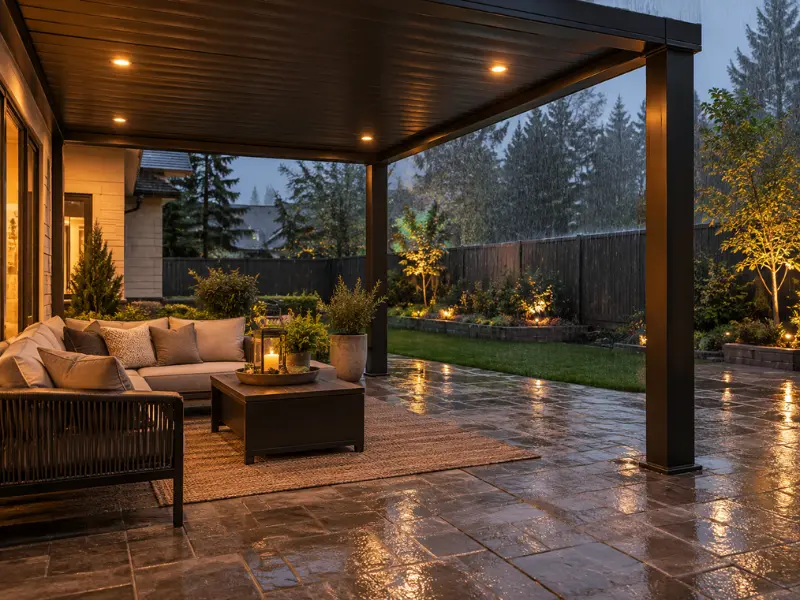
What Should You Know About Finishes and Colors?
The metal outlasts the finish, so the finish is what you are really choosing.
Most aluminium covers use a powder coat, applied as a dry powder and baked to a hard surface that resists chipping far better than wet paint. Two things determine how it ages. Fade is the pigment losing colour under UV, and chalking is the binder breaking down to leave a dusty surface. Darker colours show fade more, and both are weather-dependent rather than fixed.
Three questions worth asking any supplier: what is the finish system, is there a separate finish warranty covering fade and chalk, and can it be touched up or recoated later.
Colour range depends on the system a supplier works with, and it is worth asking to see samples outdoors rather than under showroom light. Pale finishes stay cooler and show dirt less in a pollen-heavy spring.
What Warranty Should You Expect?
Three separate ones, and conflating them is how buyers end up disappointed.
The material warranty covers the aluminium itself against structural defect. Aluminium does not rust, so this is rarely where problems arise.
The finish warranty is the one that matters more, because the coating is what degrades. It typically covers fade and chalking to a defined limit over a defined term, and it is usually separate from the material cover.
The workmanship warranty comes from whoever installs it and covers the work: footings, fixings, flashing at the ledger, and whether the thing was built to accommodate the movement described above. Most problems with a patio cover are installation problems rather than product problems, which makes this the one to get in writing.
Ask for the term in years on each of the three, and ask whether the workmanship warranty transfers to a buyer if you sell.
How Much Do They Cost, and Where Do You Build?
How much do aluminum patio covers cost depends on covered area, span between posts, whether panels are insulated or single-skin, attached or freestanding, footing depth, and any electrical. Insulated panels cost more per square foot than single-skin but need less framing beneath, so the gap on a finished job is narrower than the material price suggests.
Two Rutherford County additions belong in any quote: footings cut into an existing slab, since a four-inch unreinforced patio will not carry post loads on its own, and gutters with a discharge route that clears the foundation. Our Smyrna patio covers guide covers the local licensing tiers and why shallow limestone changes footing depth across a lot.
Free quotes, and for anything attaching to a house or sitting on an existing slab that means an on-site visit rather than a phone figure.
We build across Smyrna, Murfreesboro, La Vergne and Rutherford County, plus Nolensville, Franklin and the Nashville area. See our patio cover page, related structures on pergola and screen room, the city list on our locations page, and finished work in the gallery. Financing is available.
Searching aluminum patio covers Smyrna TN, or wondering who installs aluminum patio covers near me and which company near me installs aluminum patio covers? Ask about thermal movement and the finish warranty. Anyone comparing the best aluminum patio cover installer near Smyrna TN, or asking who installs insulated aluminum patio covers in the Nashville area, will learn more from those two answers than from a price. A good aluminum patio cover installer Nashville area TN homeowners recommend will have both ready.
Frequently Asked Questions
1. How much do aluminum patio covers cost in the Smyrna area?
Covered area and span between posts drive it first, since spanning further without intermediate posts is where the engineering cost sits. Then panel type, because insulated costs more per square foot than single-skin while needing less framing beneath, which narrows the gap on a finished job. Then attached or freestanding, footing depth, and any electrical for fans or lighting. In Rutherford County, budget separately for footings cut into an existing slab and for gutters with a discharge route that clears the foundation.
2. Do you offer free aluminum patio cover quotes?
Yes, and for anything attaching to the house or landing on an existing slab it means visiting rather than quoting from a description. Three things have to be seen: what sits under the slab perimeter, since a four-inch unreinforced patio will not carry post loads; how the cover ties into the existing roofline if it attaches; and where water will discharge once the roof creates a new catchment area. Bring your questions about span too, because span is what moves the number most.
3. Why choose aluminum over wood for a patio cover in Tennessee?
Moisture and maintenance. Aluminium cannot rust, since rust is iron oxide and there is no iron in it, and the oxide layer that forms instead seals rather than flakes, so a scratch stops rather than spreads. It also does not rot, warp, or need a refinishing cycle, which matters in humidity. Wood can look better and suits some houses more, but it needs an owner prepared to maintain it. Our aluminium versus wood guide sets out the full comparison including where timber wins.
4. Are your aluminum patio covers insulated and what colors are available?
Insulated and single-skin are genuinely different products rather than an upgrade tier. An insulated panel is a foam core between two aluminium skins, structural enough to span post to post without framing underneath, which cuts radiant heat, reduces rain noise substantially, and largely removes condensation. On colours, ask to see samples outdoors rather than under showroom lighting, and ask whether the finish carries its own warranty against fade and chalking, since the coating degrades long before the metal does.
5. What warranty comes with an aluminum patio cover?
Expect three separate warranties rather than one, and check the term on each. The material warranty covers the aluminium against structural defect, which is rarely where trouble starts. The finish warranty covers the powder coating against fade and chalking, and matters more because the coating is what ages. The workmanship warranty covers the installation: footings, fixings, ledger flashing, and whether the build accommodates thermal movement. Most patio cover problems are installation problems, so ask whether that one transfers if you sell.
Contact JB's Enclosures
JB's Enclosures 1349 Marymont Dr. Murfreesboro, TN 37129 Phone: (615) 713-7902 Veteran-owned, serving Smyrna, Murfreesboro, La Vergne and Rutherford County, plus Nolensville, Franklin and the Nashville area.
Comparing covers? Request a free on-site estimate or call (615) 713-7902, and ask us how the fixings handle expansion.
