Do Solid Patio Covers Keep Rain Off Completely in Franklin?
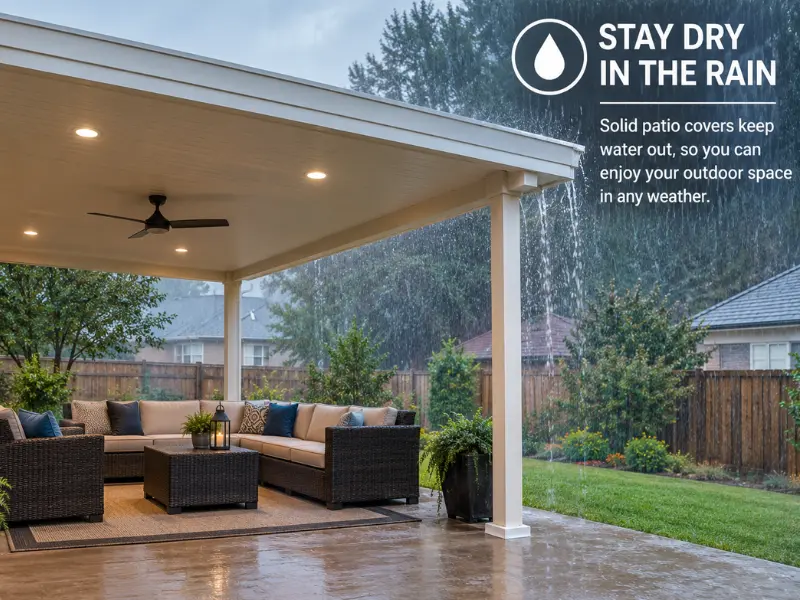
Yes, and that's really the whole pitch. Solid Patio Covers use a continuous roof panel rather than open slats, which means the space underneath stays dry in a downpour, not just shaded on a sunny afternoon. That distinction matters more in Middle Tennessee than people expect, since Nashville's National Weather Service office has tracked rainfall climbing to around 50 inches a year under the latest 30-year climate normals, up from roughly 47. A structure that only blocks sun doesn't do much on the days that actually drive people indoors.
By Jeremy Bolton, Founder and Owner · Last updated September 30, 2026
What's the Real Difference Between a Solid and a Lattice Patio Cover?
A solid cover is a continuous panel, whether that's aluminum, insulated aluminum, or another closed roofing material, running edge to edge with no gaps. A lattice cover, which is essentially what a pergola is, uses spaced slats or an open lattice pattern instead. Both structures shade a patio. Only one of them sheds water.
Solid versus lattice patio cover Franklin homeowners weigh usually comes down to how they actually want to use the space. A lattice or pergola lets dappled light through and reads as more open, which a lot of people like for a garden or dining area they mainly use on clear days. A solid cover trades some of that openness for weather independence: rain, hail, and falling debris all stay on the roof rather than coming through to the patio floor.
We build both, and our pergola page covers the open-lattice option if that's closer to what you're picturing. This piece is about what you get with the solid version specifically.
Does a Solid Cover Really Keep Rain Off Completely?
Yes, as long as the roof is properly pitched and flashed where it meets the house, which is the part that actually determines whether "solid" holds up in practice.
Feature | Solid Cover | Lattice / Pergola |
Rain protection | Full coverage, stays dry underneath | None to minimal, rain passes through |
Direct sun blocked | Nearly 100% | Roughly 40-60%, filtered/dappled |
Typical use case | Year-round outdoor room, furniture, electronics | Garden seating, dining on clear days |
Wind-driven rain | Blocked at the roof; open sides still let some in | Not addressed |
Visual feel | More enclosed, shade structure | More open, airy |
A pitched solid roof sheds water off to one side rather than letting it pool. Proper flashing where the panel meets the house wall is what keeps water from working its way in at that seam over time. That seam, more than the panel itself, is where a poorly installed solid cover actually fails.
One caveat worth being upfront about: a solid roof keeps rain from coming down on you, but it doesn't block wind-driven rain coming in sideways from an open side. On a covered patio with no walls, a hard south wind during a Tennessee thunderstorm can still carry rain a few feet in past the edge of the roofline, solid or not. That's a screen room or wall panel question, not a roof question. Our screen room page covers the option of closing in the sides if wind-driven rain is a real concern for how you'll use the space.
How Much Light Does a Solid Roof Patio Cover Franklin Homes Actually Lose?
More than a pergola, by design, which is the trade-off you're making on purpose.
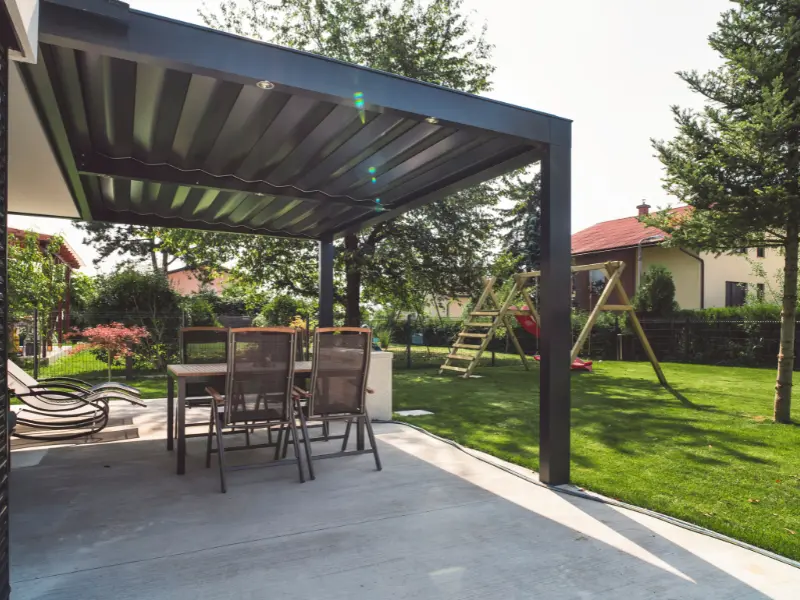
A solid roof patio cover Franklin homeowners install blocks close to all direct overhead sunlight, which is exactly why it works so well for full shade. What that means day to day is a noticeably darker, cooler space underneath compared to open sky or a slatted structure. For a reading nook, an outdoor TV, or a space you want usable at midday in July, that's the point. For a spot where you actually want some sun to reach potted plants, or you like a brighter feel while you eat breakfast, it's worth thinking through before committing to full coverage over the whole area.
The angle of the roof changes this too, not just the panel itself. A cover pitched to shed water toward the south, where Franklin gets its strongest summer sun, blocks more overhead light in the peak afternoon hours than one pitched a different direction. It's a small design detail most homeowners never think to ask about, but it affects how the space actually feels once it's built.
Some homeowners split the difference by covering part of the patio solid and leaving another section open or lattice-covered, which keeps a sunny spot and a fully sheltered one on the same patio.
Who Installs Solid Roof Patio Covers in Franklin?
Ask to see a completed solid cover in person if you can, not just photos, since the flashing detail at the house wall is hard to judge from a picture.
Who installs solid roof patio covers in Franklin well should be able to explain their flashing and pitch approach without prompting, since that's the actual engineering that makes "keeps rain off completely" true rather than just a sales line. Which patio cover style gives full shade and rain protection is really the solid-versus-lattice question again, and the honest answer depends on how you plan to use the space, not which one sounds nicer.
JB's Enclosures is veteran-owned with 20+ years building custom aluminum patio covers, screen rooms, decks, and carports across Franklin, Cool Springs, Westhaven, Brentwood, Nolensville, and the wider Nashville area. A solid patio cover installer Franklin homeowners can trust should walk you through both solid and lattice options at the estimate, not steer you toward whichever is easier to build that week. Anyone comparing the best solid patio cover installer near Franklin should ask to see both types of completed work before deciding.
See our patio cover page, our insulated patio cover guide if thermal performance and wiring matter to you, and completed local builds on our Franklin service area page.
Frequently Asked Questions
1. How much do solid patio covers cost in Franklin?
Solid covers generally run more than a comparable lattice or pergola structure, since a continuous panel uses more material and needs proper flashing and drainage detailing, which an open lattice design needs little of. Beyond the roof type, the usual factors apply: covered square footage, whether it attaches to the house or stands freestanding, and footing depth. We price from on-site measurements rather than a flat rate per square foot.
2. What is the difference between a solid and a lattice patio cover?
A solid cover is a continuous panel that sheds rain, while a lattice cover uses spaced slats that don't. The full comparison is in the table above.
3. Will a solid cover keep the patio dry in heavy rain?
Yes for straight-down rain, as long as the roof is properly pitched and flashed at the house wall. Wind-driven rain from an open side is the exception, covered in the caveat above.
4. How much natural light will a solid cover block?
Close to all direct overhead sunlight. How roof pitch affects that, and the option of covering only part of the patio, are covered in the light section above.
5. Can a solid cover be attached to an existing roofline?
Usually yes, and attaching to the house is actually the more common installation, but it depends on the condition and pitch of your existing roofline and requires proper flashing where the two meet. We check that at the site visit, since a mismatch in pitch or a roofline that can't take the ledger attachment safely is what turns an attached design into a freestanding one instead.
Contact JB's Enclosures
JB's Enclosures 1349 Marymont Dr., Murfreesboro, TN 37129 Phone: (615) 713-7902 Veteran-owned, serving Franklin, Cool Springs, Westhaven, Brentwood, and Nolensville, plus Murfreesboro, Smyrna, and the wider Nashville area.
Trying to decide between solid and lattice? Request a free on-site estimate or call (615) 713-7902, and we'll walk both options against how you actually plan to use the space.
