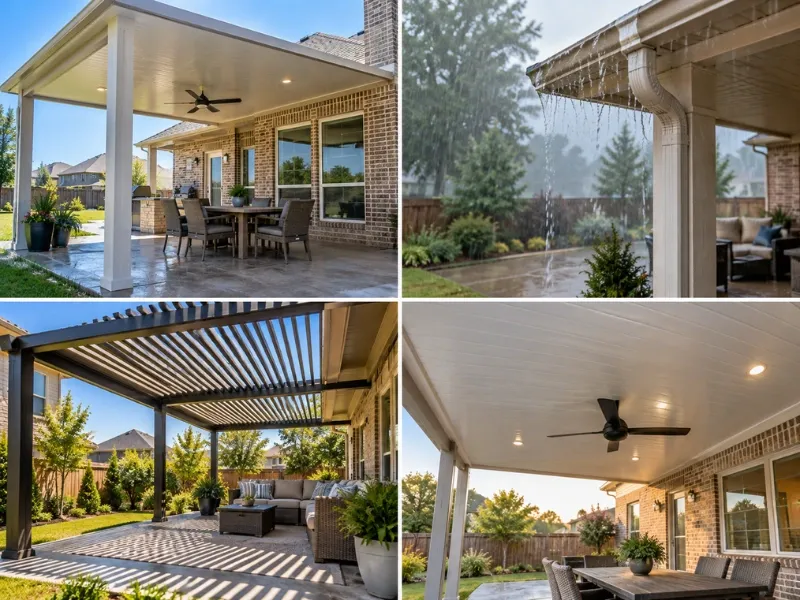
How Do Patio Covers Handle Mt. Juliet Rain And Heat?
Patio covers handle Mt. Juliet's rain and heat by putting a sloped roof over your patio that sheds water into a gutter and blocks the afternoon sun. A solid patio roof keeps storms off from above. An insulated patio cover goes further, stopping the roof itself from radiating heat down on you. JB's Enclosures builds both across Wilson County.
ByJeremy Bolton, Founder and Owner · Last updated October 23, 2026
What happens to rain on a solid patio roof?
On a good patio roof, rain runs down a gentle slope into a front gutter and is funneled away by downspouts, so it never drips though the roof, since the panels are all snapped together to make a single sealed surface.
Most people asking do patio covers keep rain out are really asking about the edges. That's where the details matter:
The slope has to fall away from the house, or water pools against your siding
The attachment point gets flashed or sealed where the cover meets your fascia or roof
The gutter has to be sized for a Middle Tennessee downpour, not a light shower
The downspouts need to dump water away from the patio, not onto it
What a roof can't stop is sideways rain. When a spring storm pushes through Wilson County with wind behind it, the open sides will catch some spray. That's why many of our Mt. Juliet customers pair a cover with screen walls or roll-down shades on the side that faces the weather. Ourpatio cover page shows the roof styles we install.
Where that water lands matters too. Much of Middle Tennessee is clay, where water runs off much slower. So, if you have a downspout that dumps next to your slab, you're going to get a nice soggy strip of lawn for a week or so. That's why we like to either route them to splash blocks, existing drains, or to a place on the ground where the ground already slopes away. It's a minor thing, but it prevents your new cover from creating a new water hole.
Why does an insulated patio cover feel different in July?
An insulated patio cover feels cooler in July because its foam core keeps the panel from soaking up heat and radiating it back down on you. Air temperature under any cover is similar. The difference is what you feel on your skin.
Here's what happens. A standard aluminum roof shades you, but in the middle of the day the panel itself becomes hot, radiating heat down on the room anyway. It's like having a sauna in your living room, but with fewer steamy towels. An insulated panel traps in the foam core, sandwiched between two layers of aluminum. As a result, the top skin takes the sun while the underside stays close to room temperature.
There are other perks, too:
Rain is quieter, since the foam damps the drumming of a heavy storm
The ceiling looks finished, with a smooth underside instead of exposed ribs
Lights and fans wire in cleanly, because the panel hides the wiring
Panel thickness also plays a part. Thicker panels insulate a little better and can span farther between supports, which means fewer posts in your way. So for a wide patio, a thicker panel can actually simplify the layout. Ourinsulated patio cover guide explains how the wiring works in more detail.
Which patio covers fit a Mt. Juliet backyard best?
The best patio covers for a Mt. Juliet backyard depend on whether you mainly want rain protection, heat relief, or filtered sun. Here's how the three main roof types compare:
Roof type | Keeps rain off from above | Feels cool on hot afternoons | Noise in heavy rain | Best fit |
Solid aluminum | Yes | Some heat radiates down | Noticeable | Year-round dining and grilling |
Insulated panel | Yes | Yes, noticeably | Quiet | West-facing patios, fans and lights |
Lattice (open) | No | Partial shade only | None | Gardens and sunny spots |
West facing patios take the hardest afternoon sun and would benefit from being insulated, a north facing patio that is already shaded would be fine with a solid roof.
Some homeowners also question the difference between a patio cover and a pergola, In short a pergola is using open beams for filtered shade whereas a cover provides you with an actual roof. If shade is the main goal, ourMt. Juliet pergola guide walks through that option.
What should you plan before building a covered patio?
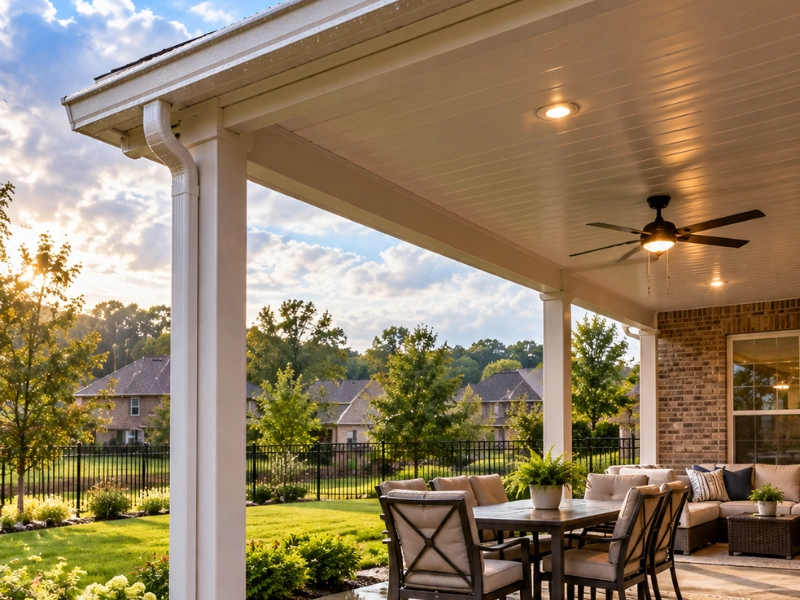
Before building a covered patio, plan how it attaches to the house, where the posts go, and what permits or HOA approvals you'll need. Those three things shape the design more than the panels do.
First, attachment. Most covers mount to the fascia board or onto the roof itself, and some stand alone on their own posts. Next, the posts. Each one needs a proper footing, and Wilson County ground is often shallow over limestone. So it's common to hit rock while digging, which we plan for up front.
Then there's paperwork. The City of Mt. Juliet's residential permit packet calls for a plot plan on additions, showing distances to your lot lines. It also lists the footing inspection as the first one done. Meanwhile, most HOA communities want to see drawings before work starts.
Finally, it's about time to think about power. If you want a ceiling fan, lights or an outdoor TV, the electrician has to know where to run the conduits before the roof is on. (Otherwise, you'll have unsightly conduits running up and down the beams.)
When people ask how much does a patio cover cost, these issues are part of the reason that one cover is different in price than another. The size, type of roof, method of attachment and footings all play a part in the cost of your patio cover.
Where do we build patio covers around Mt. Juliet and Gladeville?
We build patio covers across Mt. Juliet, south into Gladeville, and throughout the surrounding Wilson County and East Nashville area. If you're comparing patio covers in Mt. Juliet TN, we regularly work in:
Mt. Juliet: Providence, Willoughby Station, Del Webb Lake Providence, and homes near Old Hickory Lake
Wilson County: Gladeville and Lebanon
Nearby: Hermitage, Old Hickory,Nashville, andHendersonville
If you've been wondering who installs patio covers near Mt. Juliet and Gladeville Tennessee, that's us. Likewise, anyone searching for covered patio builders Mt. Juliet TN can see finished projects in ourproject gallery. OurMt. Juliet service page covers everything else we build locally.
We're a veteran-owned team with more than 20 years in the industry. When you're ready,request a free estimate and we'll come measure your patio.
Frequently asked questions
1. What does a patio cover cost in Mt. Juliet?
The cost of a patio cover is primarily driven by its size, the type of roofing, and the method of attachment to the house. An insulated panel is more expensive than a standard solid panel, and a freestanding cover has additional costs over one that is attached to the house. Upgrades such as fans, lighting, and screen walls also add to the cost. We are happy to provide a detailed estimate after measuring your patio.
2. Patio cover or pergola: which one do you actually need?
A patio cover is needed if you desire to have a space that is dry and comfortable while a pergola offers shaded areas with open space. A pergola cannot keep rain out while a patio cover can offer protection from most weather elements. You should ask yourself how many times this year have you run for cover from the rain.
3. Will a patio cover keep the rain off completely?
A patio cover will keep rain off of the cover itself, but wind will drive some rain in on the patio. How much rain gets on the patio depends on the depth of the cover and the direction your patio is facing. The deeper the overhang the better, and for the windward side, adding screen walls or roll-downs will help keep the rain off your patio.
4. Can a cover be added to an existing patio slab?
Typically, yes, a cover can be added to an existing patio slab. However, the exception is that post footings cannot be built into a standard concrete slab so we would have to cut out the area for each post and replace the slab concrete with properly reinforced post footings. The footprint of these post footings is relatively small and only replace the volume taken out of the slab for the posts.
5. Does an insulated cover make the patio noticeably cooler?
An insulated cover will make a noticeable difference in temperature on a hot summer day by reducing the amount of radiant heat that typically emanates from a metal roof. However, it will not cool the air temperature, only reduce the amount of hot air being added to the space. The amount of difference you perceive will depend on your location, which direction your patio is facing, and the time of day. The largest difference will be seen on west-facing patios on summer days from approximately 3 pm to 7 pm.
6. How long does a patio cover installation take?
Installation of an attached patio cover typically takes only a few days to install after permits are approved. Permits and HOA approval usually take longer than the installation. However, if we encounter rock while installing post footings, this too, will add time to the installation. We will always give you a timeline when we present our estimate.
7. Can I add ceiling fans or lights to a patio cover?
Yes, fans and/or lights can be added to a patio cover. An insulated panel configuration is the simplest because the electrical service to the fans and lights can be run within the insulated panel. If you have a standard solid panel roof this runs along the beam. Either way, you should plan on having the location of any fans and lights determined before your patio cover is installed.
8. Will a patio cover hold up to Tennessee storms and wind?
Yes, a properly installed patio cover will withstand severe weather and high winds. The secret is to make sure that the post footings are substantial and that the cover is well attached to the structure of your home. After severe weather, clean the gutters and make sure that the downspouts are clear.
Where can you get a free patio cover estimate in Mt. Juliet?
JB's Enclosures (Veteran-Owned) 1349 Marymont Dr., Murfreesboro, TN 37129 Phone: (615) 713-7902 Email: [email protected] Service area: Mt. Juliet, Gladeville, Lebanon, Hermitage, Old Hickory, Nashville, Hendersonville, Murfreesboro, Smyrna, and the wider Middle Tennessee area
