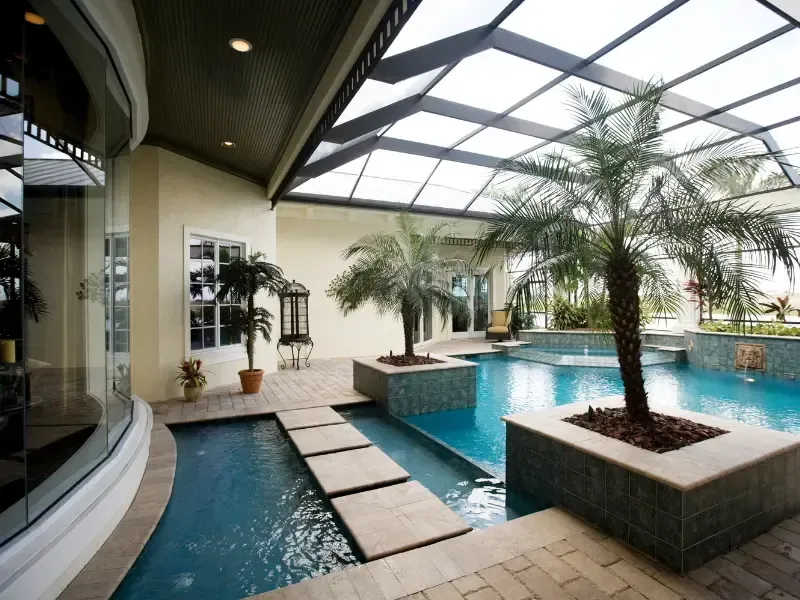
What Is a Pool Screen Enclosure and Is It Worth It in Nashville TN?
A pool screen enclosure is a framed aluminum structure wrapped in mesh screening that fully encloses your pool and pool deck — keeping out insects, leaves, debris, and unauthorized entry while letting in air and natural light. JB's Enclosures builds custom pool screen enclosures throughout Middle Tennessee, including Nashville, Brentwood, Franklin, and Murfreesboro. We're a veteran-owned company with over 20 years in the outdoor enclosure trade, and free estimates come with every project.
By Jeremy, Owner · Last updated June 2026
What Is a Pool Screen Enclosure?
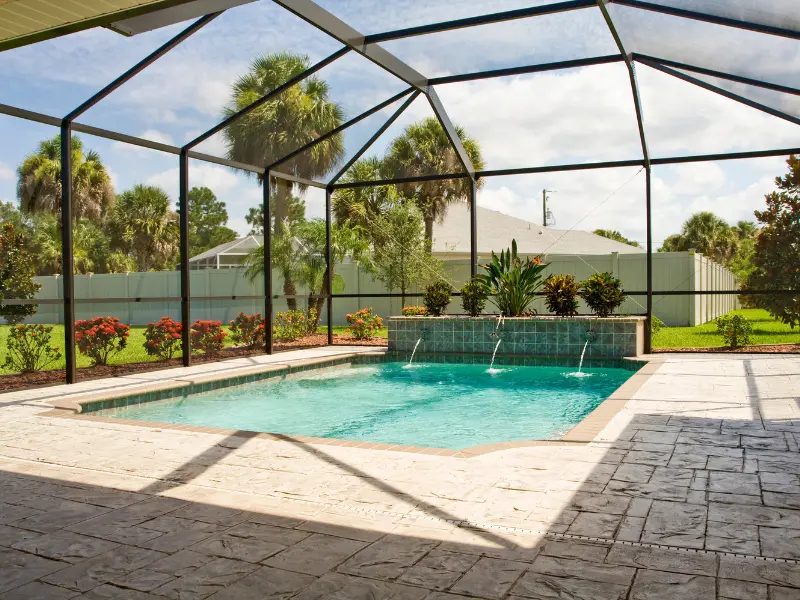
A pool screen enclosure — sometimes called a pool cage — is an aluminum-framed structure covered in fiberglass or aluminum screen mesh that encloses the entire pool area, including the deck and any adjacent patio space. It functions like a large outdoor room with a screened roof and walls, sized to cover the full footprint of your pool deck.
Unlike a basic fence or a screened porch, a pool screen enclosure is designed specifically for the pool environment: the framing is corrosion-resistant aluminum built to handle moisture, the screen is durable enough to withstand years of exposure, and the structure typically includes a screened door with a self-closing latch for safety compliance.
In Middle Tennessee, pool screen enclosures are most common on in-ground pool properties in Brentwood, Franklin, Belle Meade, and the larger-lot neighborhoods of Nolensville and Spring Hill — homes where the investment in a quality in-ground pool makes protecting that investment worthwhile. The enclosure extends the pool's usable season, dramatically cuts maintenance time, and adds a finished, intentional look to the pool area that an open pool deck can't match.
How Much Does a Pool Screen Enclosure Cost?
For most Middle Tennessee homes, a pool screen enclosure installation runs between $6,000 and $18,000 depending on pool size, deck footprint, enclosure height, and roof style. According to HomeAdvisor's 2026 pool enclosure cost guide, the national average is $12,168, with most homeowners spending between $7,051 and $18,831. Screen enclosures run $8 to $15 per square foot installed — the most affordable enclosure type by a significant margin over glass or polycarbonate systems.
Here's how cost breaks down by size and configuration in the Nashville metro market:
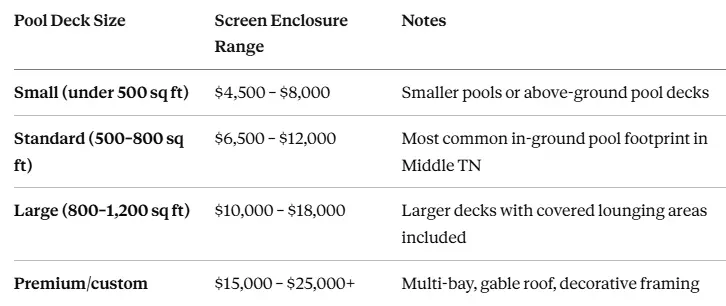
The main cost drivers: deck footprint (more square footage = more frame and screen), enclosure height (taller structures cost more in materials and installation labor), roof style (flat screen roofs are more economical; gable or hip roofs that tie into the home's architecture cost more but look significantly better on Nashville's predominantly pitched-roof homes), and screen type (standard fiberglass is most common; solar screen adds cost but blocks UV and reduces glare on the pool surface).
Per Homeyou's Nashville screen enclosure project data, the average installed cost for Nashville-area screen enclosures is approximately $9,500.
We provide free, itemized written estimates on every project. Call (615) 713-7902 to schedule.
Screen Enclosure for Pool Guide: What's Included in a Full Installation
This is the screen enclosure for pool guide Middle Tennessee homeowners need before they call a contractor. Here's what a complete pool screen enclosure installation covers — and what to watch for when comparing quotes.
Aluminum frame fabrication and installation. The structural backbone of every pool enclosure is an aluminum frame — extruded sections that form the vertical posts, horizontal beams, roof purlins, and door frames. Quality pool enclosure framing uses aluminum specifically rated for outdoor structural use, not standard residential framing aluminum. We design each frame to the specific dimensions of your pool deck, so there's no cutting corners with a standard kit that doesn't quite fit.
Screen mesh installation. The screen panels are the surface area that does the actual work — keeping insects out, blocking debris, and providing the visual definition of the space. Standard fiberglass screen is the most common choice: durable, economical, and effective for bug and debris control. Solar screen (18x14 or 20x20 mesh) is denser and blocks a meaningful portion of UV radiation — we recommend it for the roof sections of Nashville-area enclosures where afternoon sun exposure on the pool deck is a comfort concern from June through August.
Self-closing, self-latching screen door(s). A code-compliant pool enclosure in Tennessee includes at minimum one self-closing, self-latching screen door. This is a safety requirement under Tennessee Code Annotated § 68-14-802, which governs residential pool barrier requirements statewide. If a child can open the door by themselves, it doesn't meet the safety standard. We install compliant hardware on every enclosure door we build.
Foundation and anchoring. The enclosure frame attaches to the pool deck via anchor bolts set into the concrete. In Middle Tennessee, where frost penetration can affect concrete integrity over winter, we use stainless steel hardware throughout to prevent corrosion at the anchor points — an upgrade from galvanized hardware that matters at year 10 of the enclosure's life.
Permit filing. Metro Nashville and Davidson County require a building permit for pool enclosure construction. We file all permits as part of every project under JB's license. An enclosure built without a permit becomes your problem at resale.
Why Pool Screen Enclosures Make Sense for Tennessee Pool Owners
Pool screen enclosures aren't as dominant in the Tennessee market as they are in Florida, where they're essentially standard. But for Middle Tennessee homeowners who've invested in a quality in-ground pool, the case for enclosing it is stronger than most realize.
Bugs and mosquitoes. Tennessee's warm, humid summers produce some of the most active mosquito seasons in the country, particularly in the wooded suburban neighborhoods of Nolensville, Spring Hill, and the tree-heavy parts of Brentwood. A pool screen enclosure converts an open pool that's unusable at dusk into one you can actually enjoy from 5 pm on. That's a direct improvement to how much the pool gets used.
Debris management. The mature tree canopy across Middle Tennessee — oak, maple, and cedar — drops leaves, seeds, and pollen onto uncovered pools from March through November. An enclosure eliminates the daily skimming requirement, reduces filter load, and keeps the pool cleaner between swims. For pools in neighborhoods like Green Hills or Belle Meade where large hardwood trees overhang the yard, the maintenance savings are tangible.
Pool chemical savings. A screened pool needs significantly less chlorine and chemical treatment than an open one because UV degradation of the water chemistry is partially blocked by the screen material. Pool industry data consistently shows 30 to 50 percent reductions in chemical use for enclosed versus open pools. Over a 10-to-15-year enclosure lifespan, that adds up to a real number.
Safety. The self-latching door and full perimeter enclosure add a physical barrier layer beyond a standard pool fence. For households with children or properties adjacent to common areas in Brentwood or Nolensville HOA neighborhoods, this is a genuine safety upgrade that also satisfies some insurers' pool barrier requirements.
Property value. A professionally built, permitted pool enclosure adds finished square footage to the pool area and improves curb appeal. In the competitive Williamson County and Brentwood real estate markets, where outdoor living quality is a clear differentiator, an enclosed pool stands out from an open one.
What to Expect: The JB's Enclosures Process
We've been building outdoor enclosures in Middle Tennessee for over 20 years under owner Jeremy's lead. Every pool screen enclosure project we take on follows the same process: free estimate with upfront itemized pricing, permit filing, custom fabrication to your deck dimensions, and installation by our own crew — not a subcontractor you've never met.
Pool enclosure work is specialty work. It requires precise measurement, proper frame engineering for the roof load (especially during Tennessee's ice events in winter), and attention to the self-latching hardware that affects safety compliance. We don't rush it, and we stand behind the result.
Financing available starting at $125/month for qualified customers — see financing options.
Our pool screen enclosure work spans the whole Middle Tennessee area: Nashville, Brentwood, Franklin, Nolensville, Murfreesboro, Spring Hill, Mt. Juliet, Hendersonville, Smyrna, and Belle Meade.
Frequently Asked Questions
1. How much does a pool screen enclosure cost in Nashville TN?
A pool screen enclosure in Nashville typically runs $6,000 to $18,000 installed, with the national average at $12,168 and the Nashville-area average around $9,500 based on current market data. Cost depends on your pool deck footprint, enclosure height, roof style, and screen type. JB's Enclosures provides free, itemized written estimates — call (615) 713-7902 to schedule.
2. What is a pool screen enclosure and how does it work?
A pool screen enclosure is an aluminum-framed structure covered in fiberglass or aluminum screen mesh that fully encloses your pool and deck. It keeps out insects, leaves, and debris while allowing air and light through. It also provides a safety barrier with self-latching screened doors that prevent unsupervised pool access.
3. What is included in a screen enclosure for pool installation?
A complete screen enclosure for pool installation includes: aluminum frame fabrication custom-sized to your deck, fiberglass or solar screen panel installation, self-closing and self-latching screened door(s) compliant with Tennessee pool barrier code, stainless steel anchor hardware set into the pool deck, and permit filing. JB's Enclosures handles all of this under one crew with upfront pricing.
4. Do I need a permit for a pool screen enclosure in Tennessee?
Yes. Metro Nashville and Davidson County require a building permit for pool enclosure construction. Tennessee Code Annotated § 68-14-802 also governs pool barrier requirements statewide, including the self-latching door standard for any pool enclosure. JB's Enclosures files all permits as part of every pool screen enclosure project.
5. How long does a pool screen enclosure last?
A professionally installed aluminum pool screen enclosure typically lasts 15 to 25 years with normal maintenance. The aluminum frame is corrosion-resistant and handles Tennessee's climate well. Individual screen panels may need rescreening at 7 to 15 years depending on UV exposure and physical damage — rescreening runs $300 to $1,500 on average and is far less expensive than frame replacement.
Get a Free Pool Screen Enclosure Estimate in Middle Tennessee
If you have an in-ground pool in the Nashville metro and you're spending more time maintaining it than enjoying it, a pool screen enclosure is worth a serious look. JB's Enclosures delivers free estimates, upfront pricing, and permit coordination throughout Middle Tennessee.
Request a Free Estimate or call (615) 713-7902 today.
Explore related services:
Screen Rooms — Covered screened living spaces off the home
Screened Porch Nashville TN — Screened porch options for Nashville homes
Financing — Starting at $125/month
Contact JB's Enclosures
JB's Enclosures 1349 Marymont Dr Murfreesboro, TN 37129 Phone: (615) 713-7902 Email: [email protected]
Serving Nashville, Murfreesboro, Brentwood, Franklin, Nolensville, Smyrna, Hendersonville, Mt. Juliet, Spring Hill, Belle Meade, Madison, and all of Middle Tennessee.
